AI Architecture AI automation AI performance Artificial Intelligence Classification LLM Software Architecture
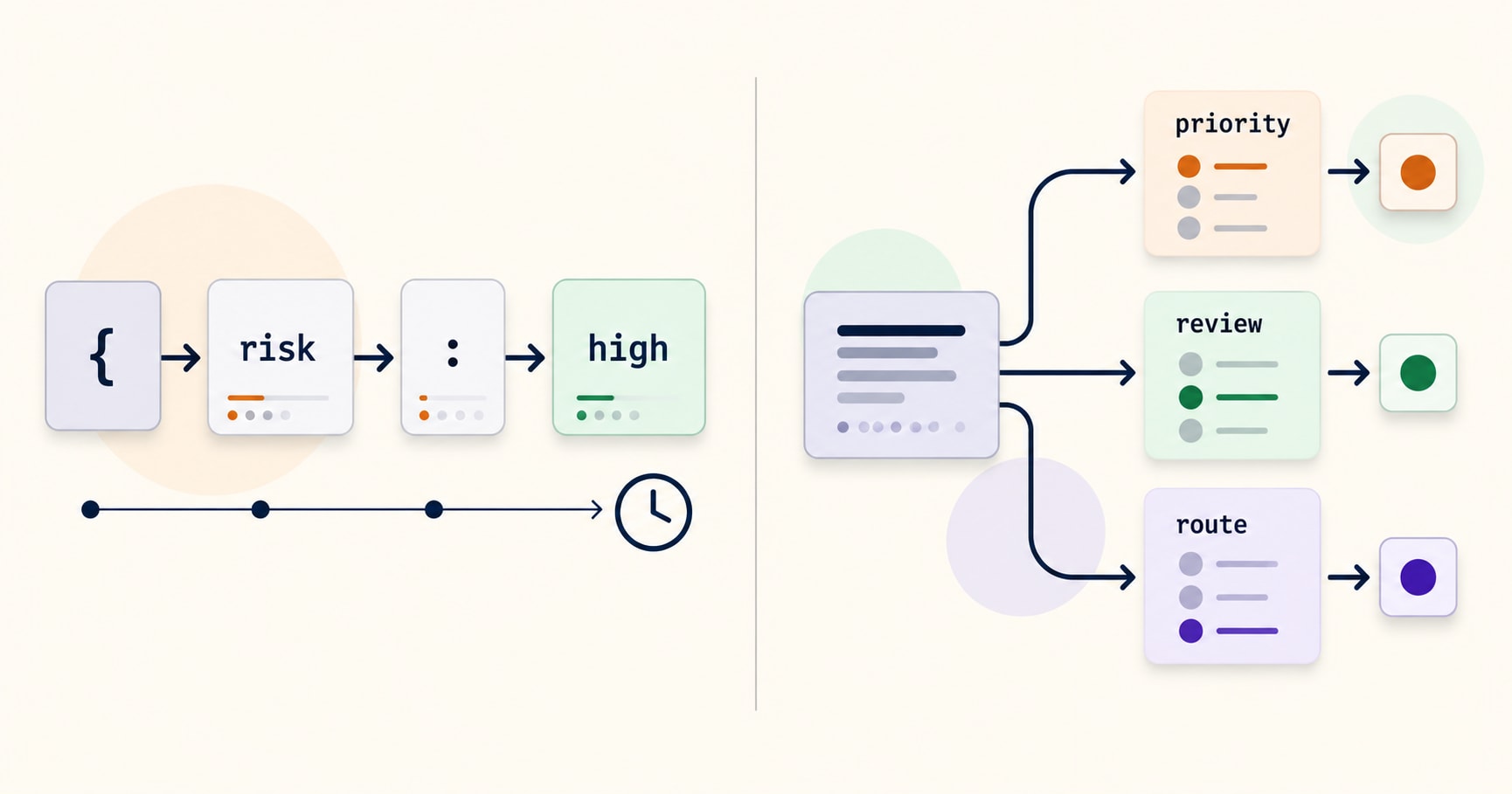
How Jev Works: The Parallel Decision Model That Skips Token-by-Token JSON

How Jev works starts with a simple observation: most software does not need an AI system to write an essay. It needs a dependable answer to a bounded question. Should this support ticket be escalated? Which queue owns it? Is the document complete? Should an agent stop and ask a person for help? That is […]

AI Architecture AI automation AI performance Artificial Intelligence Software Architecture

How Jev Works: The Parallel Decision Model That Skips Token-by-Token JSON

How Jev works starts with a simple observation: most software does not need an AI system to write an essay. It needs a dependable answer to a bounded question. Should this support ticket be escalated? Which queue owns it? Is the document complete? Should an agent stop and ask a person for help? That is […]

AI Architecture AI automation AI performance Artificial Intelligence Software Architecture

How Jev Works: The Parallel Decision Model That Skips Token-by-Token JSON

How Jev works starts with a simple observation: most software does not need an AI system to write an essay. It needs a dependable answer to a bounded question. Should this support ticket be escalated? Which queue owns it? Is the document complete? Should an agent stop and ask a person for help? That is […]

AI Architecture AI automation AI performance Artificial Intelligence Software Architecture

How Jev Works: The Parallel Decision Model That Skips Token-by-Token JSON

How Jev works starts with a simple observation: most software does not need an AI system to write an essay. It needs a dependable answer to a bounded question. Should this support ticket be escalated? Which queue owns it? Is the document complete? Should an agent stop and ask a person for help? That is […]

AI Architecture AI performance LLM Software Architecture Software Engineering

Why LLMs Pause Before They Start: Time to First Token Explained

Time to first token (TTFT) explains a familiar LLM behaviour: a noticeable pause before the first word, followed by a stream of much faster tokens. If a model needs 1.5 seconds to begin but delivers later tokens roughly every 30 ms, the gap is usually the result of how transformer inference works, not simply a […]

Subscribe to Our Newsletter

We don’t spam! Read our privacy policy for more info.