
Games Made With Astra: 7 AI Game Experiments and Lessons for Developers
Quick summary
- Seven experiments: The article examines reported examples of Astra contributing to game prototyping and development.
- Follow the development loop: Useful assistance includes interpreting a brief, editing, running the game and repairing observed problems.
- Distinguish levels of involvement: Generating a prototype, editing a project and testing gameplay are different contributions.
- Keep human ownership: A playable demo still needs design judgement, playtesting, accessibility and production review.
Games made with Astra are moving beyond the one-line “make me a game” prompt. The useful question is whether an AI agent can participate in a real development loop: interpret a brief, edit a project, run it, observe a fault and make a bounded repair. The early evidence is interesting, but it needs careful reading. A playable prototype is not proof of a finished, commercially ready game.
This article examines seven documented experiments and the technical lessons that transfer to ordinary game development. For the broader workflow from prompt to tested web-game prototype, see Games with Astra: How AI Is Changing Game Development.
What the “games made with Astra” claim should mean
Online claims can conceal very different levels of AI involvement. A model might help with a function, generate a browser prototype, edit a Unity or Godot project, or run and test the game after changing it. Those are not equivalent. Here, “made with Astra” means Astra was reported to contribute materially to implementation, prototyping or iteration. It does not mean a model independently created a balanced, original, accessible and commercially viable game.
That final level still needs people: game design, art direction, playtesting, technical ownership, accessibility and legal review.
1. Playco: three themes from one grey-box foundation
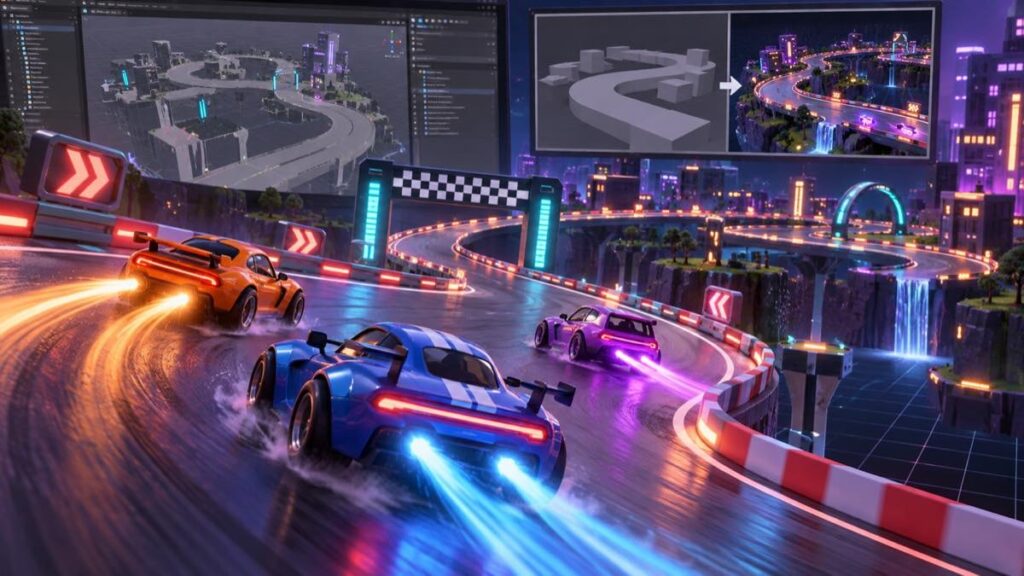
The clearest documented example comes from Playco. In an OpenAI case study, Playco describes using GPT-6 Astra in Playbot, an AI-powered environment connected to Unity and Godot. The company says the model can edit scenes, play and test games, validate changes and work inside existing development tools.
Playco began with a plain grey-box prototype built from simple primitives, then developed three themed prototypes from the same foundation. It reports that most worked on the first attempt and required 50% fewer manual fixes than its previous-model workflow. This is Playco’s reported result, not an independent benchmark.
The important lesson is architectural. A grey box proves movement, camera, objectives and feedback before a team invests in art. Keep the reusable loop separate from presentation:
Input → player state → rules → world response → feedback → win/loss state
For a collection game, the player moves, overlaps a collectible, increments a counter, unlocks a gate at a threshold and reaches an exit. A sci-fi or fantasy theme may alter the art and sound, but it should not require the rules to be rebuilt. AI becomes much more useful when that spine is stable.
2. A Catan-style Three.js board-game experiment
A curated Astra demonstrations index links to a Catan-style Three.js board-game experiment with animated pieces, guidance cards, AI opponents and player trading. It is more than a visual scene: a strategy game needs durable state management. Because this is a curation source, it should be read as a community demonstration, not an independently audited production release.
At minimum, a turn-based game needs a serialisable state model for the active player, board, resources, phase and valid actions.
const gameState = {
  currentPlayerId: "player-1",
  turnNumber: 4,
  phase: "trade",
  players: [{ id: "player-1", resources: { wood: 2, brick: 1, grain: 3 } }]
};
For Astra game development, define pure rule functions before asking for visual polish. Test invalid trades, insufficient resources, invalid placements and turn changes. Then make the Three.js layer render the state, rather than silently owning the rules.
3. Circuit Shift: a bounded Godot prototype with real checks
Circuit Shift is a documented small Godot puzzle game with three rooms, collectible cells, relay switches, gates, moving hazards, menus, settings and saved progress. Its case study describes repeated engine runs and gameplay checks rather than a one-off source-code generation step.
Its scope is deliberately constrained. Walls must block movement; a gate must block movement while closed; collecting cells must enable the exit; hazards must cause a loss; restart must reset the room; progress must survive a relaunch. Those are observable acceptance criteria, which make an AI brief testable.
The case study also shows why testing is not enough on its own. Gameplay assertions passed, but screenshot inspection identified an unreadable keyboard-focused button. The game worked; the interface was not yet usable. Every AI-assisted prototype needs both automated checks and visual review of focus states, small layouts, contrast and first-time-player guidance.
4. Sunwake: visual direction is not game design
The demonstrations index also lists Sunwake, a sailing-game experiment with moving waves, colourful ocean lighting and multiple rendering styles. It illustrates a real strength: Astra can rapidly explore art direction while preserving a gameplay idea.
But atmosphere is not a game loop. A sailing game still needs an objective, tension, choices, learning and a reason to return. Developers should use AI to generate controlled alternatives: preserve boat physics, camera distance, controls and performance budget; vary only lighting, water treatment, sky, props, palette and interface tone. That gives a human designer meaningful options without changing the game underneath.
5. Jelly Baby Playground and measurable physics

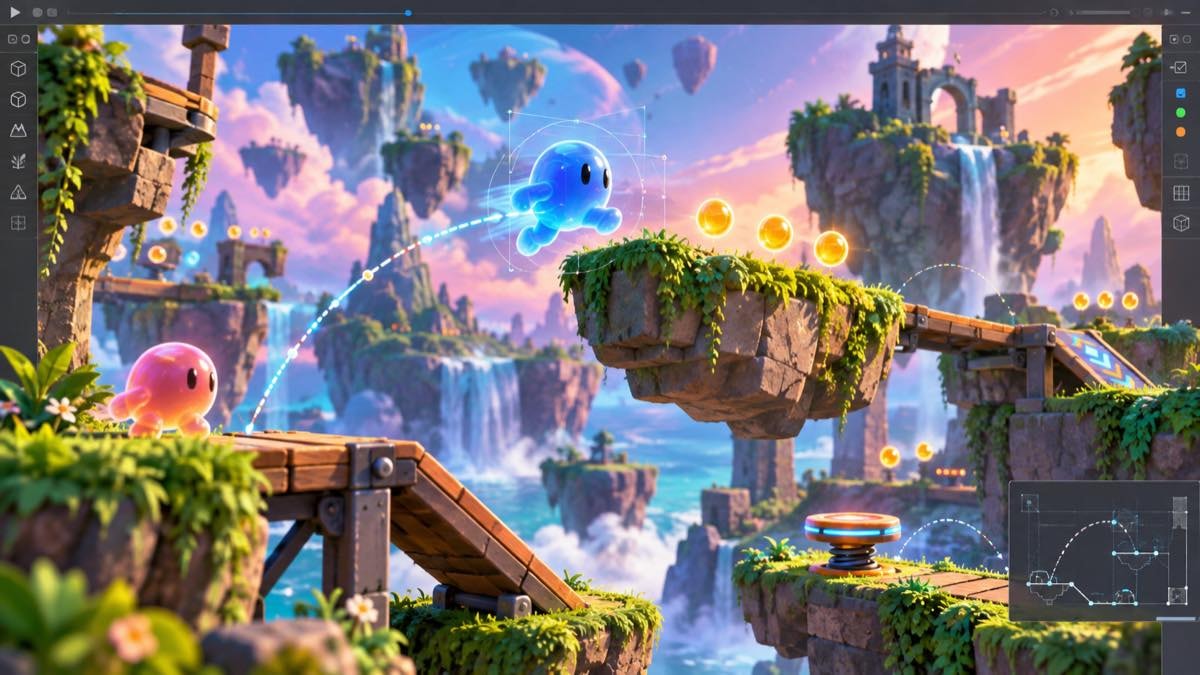
Jelly Baby Playground, also linked by the demonstrations index, is a browser experiment around a soft character that can be stretched, thrown and bounced. Physics playgrounds make useful AI testbeds because errors are visible: clipping, unstable joints, bad gravity, collision errors and unreliable touch input.
“Make the physics feel good” is too vague. Instead, set measurable constraints:
- The character must not fall through static geometry after 1,000 simulated frames.
- It must settle within three seconds after release.
- Drag input must not trigger page scrolling on mobile.
- The game must remain playable at 30 frames per second.
Diagnostics such as frame rate, active bodies, collision events and player velocity give an agent evidence it can use to make a targeted repair.
6. No Moat: make the theme alter the mechanics
A browser-game collection lists No Moat, a roguelike deckbuilder about running an AI startup. Its reported loop includes recruiting teammates, building a deck and dealing with copycats, bugs and cloud bills. The collection explicitly says it cannot verify the model version behind every listed game; it documents hosting and authorship rather than claiming every entry is an Astra-only workflow.
Its useful design lesson is that a theme should alter decisions, not merely artwork. Cloud costs can become upkeep; technical debt can make a powerful card create a later penalty; copycats can duplicate a successful strategy. When briefing Astra, ask it to map the theme to rules, cards, enemies, rewards and failure states.
7. Mini Moto and readable simulation
The same collection includes Mini Moto, described as a motocross simulation where players shape dirt, configure rider skill and race strategy, then watch riders lap a course. It highlights a useful pattern for AI-built games: visible variables and cause-and-effect.
rider: speed, stamina, aggression, cornering skill
track: surface grip, jump difficulty, turn radius, weather
A simulation works when a player can change something, predict the effect, observe the outcome and revise their theory. Ask Astra to expose that loop with tooltips, race summaries, event logs, replay controls and visualisation of the important variables.
What these Astra game experiments actually show
These examples show that prototype volume can rise, small projects can include more essential product work, and engine feedback matters as much as generated code. The valuable loop is:
Brief → implementation → engine run → test or screenshot
→ defect report → targeted repair → regression check
That shifts the bottleneck toward judgement. Someone still needs to decide which idea is worth developing, whether a mechanic is understandable, whether the art direction is coherent, whether performance is sufficient and whether players enjoy the game.
What Astra should not decide alone
Avoid using a named game, franchise, character or recognisable art style as the basis of a commercial brief. Community demonstrations sometimes include fan works and unofficial remakes. They may be technically interesting, but they are not a safe product foundation.
Keep people responsible for balance, accessibility, security and release decisions. A browser game should not expose secrets in client-side code, trust unverified score submissions or rely on unreviewed third-party scripts. Automated completion does not prove accessibility, enjoyment or commercial readiness.
A practical workflow for your own Astra game
- Define one repeatable loop. For example: explore, collect power cells, avoid sentries, unlock an exit and reach the next room.
- Write observable acceptance criteria. Include input, collision, state changes, restart, save behaviour and small-screen usability.
- Build systems before spectacle. Create the state model, rules and tests before art-direction polish.
- Require evidence. Ask for changed files, test results, screenshots, known limitations and defect reproduction steps.
- Run a human playtest. A successful test run means the game functions; it does not mean a new player understands or enjoys it.
Conclusion
The most useful games made with Astra are not necessarily the most photorealistic or viral. They are the ones that expose a disciplined workflow: a clear brief, a small playable loop, engine-driven evidence and human judgement over the final experience.
Playco’s grey-box workflow shows how AI can accelerate concept exploration. Board-game and simulation experiments show why state and feedback still matter. Godot prototypes show why visual inspection must accompany automated tests. Astra changes where developer value is concentrated: system design, player empathy, creative direction, verification and the willingness to refine a game beyond its first playable build.
Sources and licences
- OpenAI: Playco game prototyping with GPT-6 Astra
- GPT-6 Astra demonstrations index
- Circuit Shift Godot case study
- Floating Arcade: collection methodology and examples
- Board-game image: public domain, Linda Bartlett / U.S. National Cancer Institute
- Controller image: CC0, Evan-Amos
The post Games Made With Astra: 7 AI Game Experiments and Lessons for Developers appeared first on Alpesh Kumar.