
Genie: Generative Interactive Environments for playable (action-controllable) worlds
Quick summary
- Interactive generation: The article introduces Genie as a model for generating controllable environments from visual inputs.
- Learning from video: It describes learning patterns of movement and interaction without explicit action labels.
- Creative possibilities: Sketches and images provide starting points for exploring generated worlds.
- Research direction: The article considers uses in creative prototyping and environments for training AI agents.
Imagine if you could take a doodle, a photograph, or even a dream and turn it into a living, breathing virtual world. That’s not the beginning of a sci-fi novel; it’s the reality with Genie. This cutting-edge AI isn’t just a leap forward; it’s a quantum leap into the future of interactive, generative environments. Let’s dive into the magic that makes Genie not just a tool, but a doorway to endless worlds of adventure and creativity.
The Magic Behind Genie
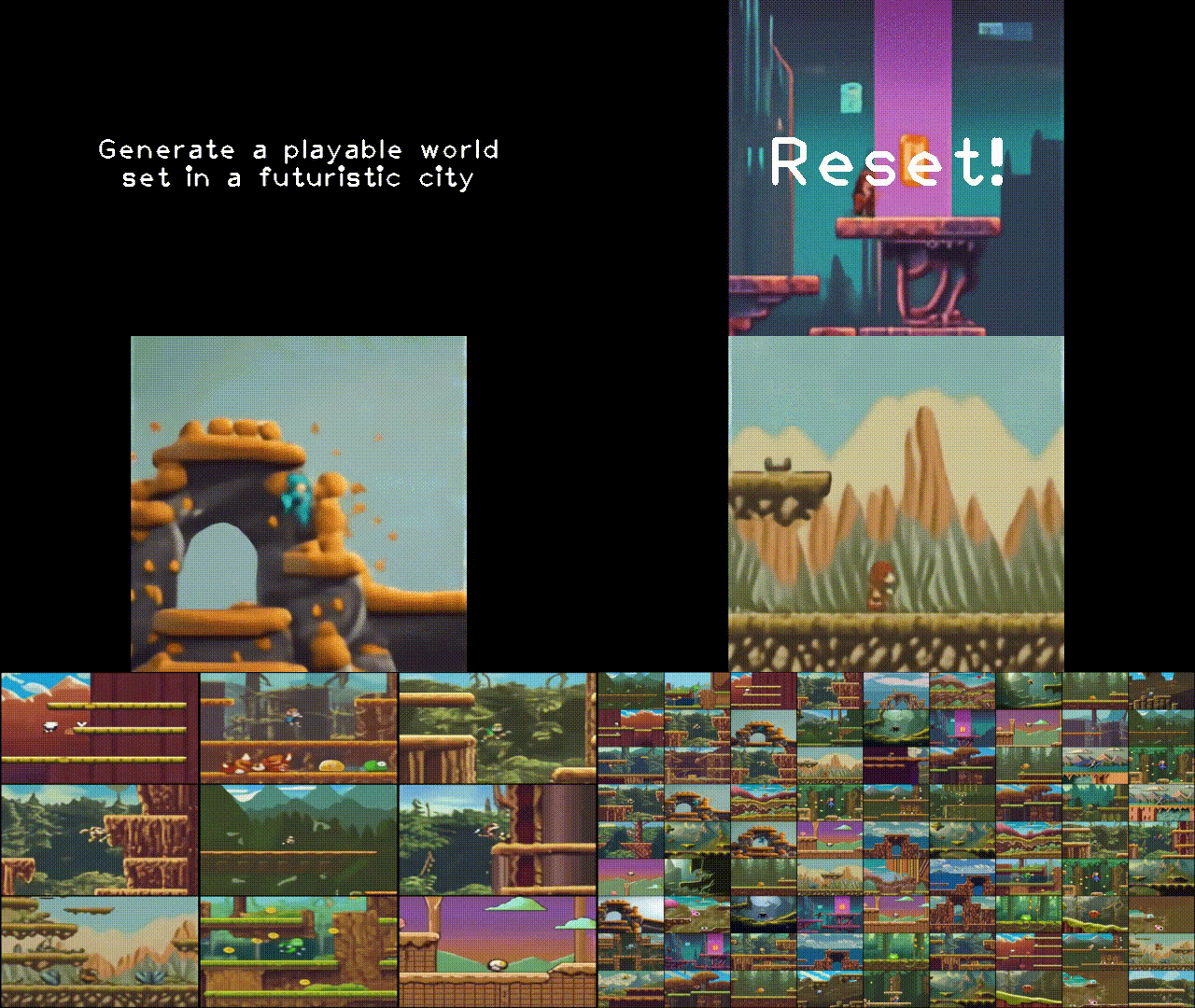
At its heart, Genie is like the genie from the lamp—except instead of granting three wishes, it brings images to life. Feed it a picture, and it creates a world where you can play, explore, and interact. How? By learning from countless internet videos, Genie has mastered the art of creating dynamic, controllable environments without being directly told how. It’s as if it can read the visual language of our world and translate it into interactive experiences.
No Labels, No Problem
One of Genie’s most astonishing tricks is its ability to understand and create without needing explicit instructions. It looks at videos—without any hints or labels—and figures out which parts can move and how. Then, it applies this knowledge to make new worlds from static images. Whether it’s a sketch on a napkin or a snapshot from your last vacation, Genie can turn it into a place you can visit and explore.
A Canvas for Creators
What if you could step into your drawings or wander through a landscape you’ve only seen in a dream? With Genie, artists, dreamers, and creators of all kinds can see their visions come to life. It’s not just about generating images; it’s about breathing life into them, making them explorable. From sketches to snapshots, Genie transforms the flat, static images into vibrant, dynamic worlds waiting for adventure.
Training Ground for Tomorrow’s AI
Beyond the wonder of creating new worlds, Genie is also shaping the future of Artificial Intelligence itself. Traditional AI training grounds are limited by the number of environments they can simulate. Genie breaks these boundaries, offering endless, ever-changing landscapes for AI to learn and grow. It’s not just about making games; it’s about building a smarter, more adaptable generation of AI.
A Universe of Possibilities
Genie’s potential stretches far beyond any one application. It’s a tool, a teacher, and a canvas, all rolled into one. From simulating the delicate fold of a shirt to conjuring vast, explorable worlds from a single image, Genie represents a new frontier in AI. It’s not just about what it can do today but what it promises for tomorrow: a world where our imagination is the only limit.
So, as we stand on the edge of this new digital horizon, let’s not just think about what Genie is but what it can become. It’s more than technology; it’s a portal to the unimaginable, a key to worlds we’ve only dreamed of. Welcome to the era of Genie, where the future of creativity, exploration, and AI blends into the adventure of a lifetime.
Read this Genie article as a research overview
The research linked in this article is the original 2024 Genie project. The publication date of this page and the “-2” suffix in its address do not identify a newer model generation. Keeping that distinction clear avoids mixing claims from different systems. The Google DeepMind research entry is the reference point for the unsupervised interactive-environment work discussed here.
The central idea is to learn useful environment dynamics from visual sequences without explicit action annotations. That creates a route from passive observation toward controllable generation. It does not mean the model has recovered a complete physical description of the world or that arbitrary input images will always produce dependable experiences.
Evaluate an environment from an agent’s perspective
Imagine a hypothetical agent trying to move a character towards a visible target. It needs more than attractive frames. The available actions must have sufficiently consistent effects, the target must remain recognisable and progress must be distinguishable from failure. Without those properties, a high-looking success rate could reflect flaws in the environment rather than useful behaviour.
Start with a short, bounded task. Record the initial scene, the action sequence and the observed outcome. Repeat comparable trials and check whether the environment preserves important objects. A single successful trajectory is a demonstration; repeated performance under varied conditions provides stronger evidence of reliability.
Also look for shortcuts. An agent might discover an action that exploits a visual inconsistency instead of completing the intended task. This possibility is familiar in simulation work: the training objective and the environment together determine what behaviour receives a reward. A generated world adds another source of uncertainty that the evaluator must examine.
Keep creative prototyping and validation distinct
A designer exploring possible worlds can tolerate some instability because unexpected changes may inspire ideas. An evaluator measuring an agent’s capability needs tighter control. These uses call for different standards, even if they begin with the same generated scene. Decide which purpose matters before choosing a success metric.
For a creative prototype, write down what the scene communicates and what interactions feel understandable. For an evaluation environment, document the task boundaries, known failure modes and conditions under which results should be discarded. This keeps an appealing visual experience from becoming stronger evidence than it deserves to be.
The site’s guide to evaluating AI agents offers a related principle: inspect the path and verify the outcome. Applied to Genie, that means looking beyond the final frame to the sequence of actions and responses that produced it. The research opens an interesting direction, and careful evaluation determines which applications that direction can support.
The post Genie: Generative Interactive Environments for playable (action-controllable) worlds appeared first on Alpesh Kumar.