
Your First Personal AI Agent: A Focused Weekend Build
Quick summary
- Give a personal agent one narrow job, clear inputs, and an output you can inspect.
- Treat instructions, tools, guardrails, and remembered context as separate choices.
- Begin with read-only access and require human approval before an external action.
- Test representative examples before expanding the workflow.
The fastest way to get value from a personal AI agent is to stop imagining an AI employee. Start with one routine that is mildly annoying, happens often, and produces work you can easily review. In a couple of hours, you can prototype a useful workflow. You cannot reasonably expect a dependable, unattended assistant that understands every exception.
A good first agent does one job: it turns known inputs into a draft you check. Think meeting notes into weekly priorities, a collection of product feedback into recurring themes, or a set of links into a research brief. The goal is not autonomy. The goal is a reliable starting point that saves you from a blank page.
Choose a task with a low cost of being wrong
Pick a task where the source material is already available, the desired result has a familiar shape, and a mistake is easy to catch. A weekly priorities draft is a good example. You provide meeting notes, the agent identifies possible priorities, and you decide what actually makes the list.
That differs from asking an agent to manage your calendar, send messages, or make decisions on your behalf. Those tasks add permissions, side effects, and more ways for a reasonable-looking answer to become an expensive mistake.
Use this simple filter before you build:
- Can I describe the task in one sentence?
- Do I know exactly what material the agent may use?
- Can I recognise a useful answer quickly?
- Is the result still safe if it remains a draft?
If the last answer is no, narrow the task. A first agent should make a recommendation or prepare work, not take irreversible action.
Write the agent contract before choosing a framework
Most first attempts fail because the job is vague. Before selecting a model, SDK, or no-code tool, write a small contract. It should say what the agent is, what it can see, how it should respond, and where it must stop.
For the meeting-notes example, the contract might be:
Role: Prepare a draft weekly priorities list.
Input: Notes supplied for the current week only.
Output: Three to five priorities, each with a short rationale.
Boundaries: Do not invent commitments. Flag unclear items.
Approval: A person reviews the draft before it is shared.
This is an illustrative template, not a universal prompt. Its value is that it makes assumptions visible. If the notes do not contain enough evidence for a priority, the agent should say so rather than quietly filling the gap.
The current OpenAI Agents SDK documentation separates related concepts such as agents, tools, guardrails, sessions, tracing, and handoffs. You do not need every component for a first build. The distinction is still useful: instructions define the job, tools provide limited capabilities, guardrails set boundaries, and session context determines what information remains available across a workflow.
Build the smallest useful path
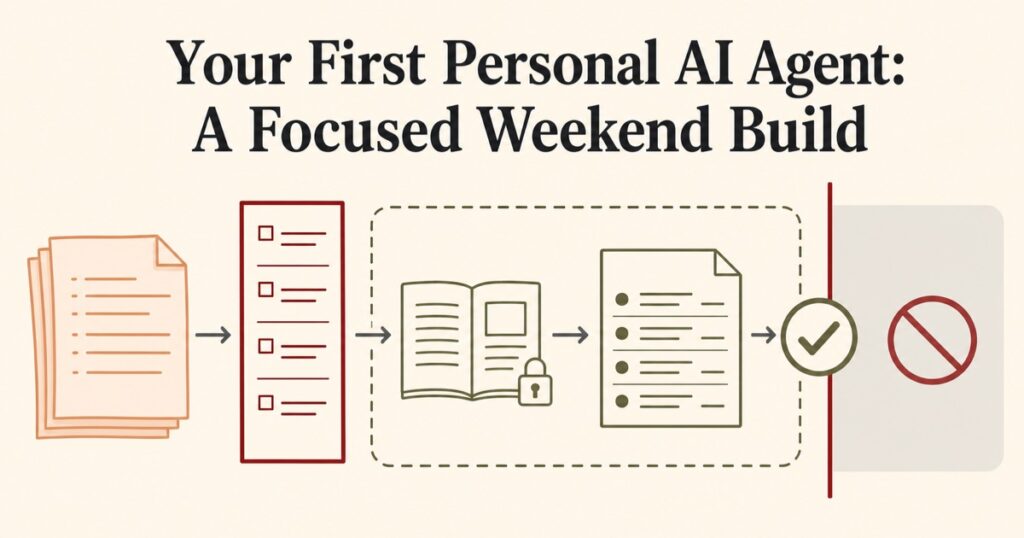
A first prototype can be deliberately plain. Collect the source material, apply your contract, optionally let the agent use one read-only lookup, and ask it to return a structured draft. Review the result. Only after that should you consider sending, creating, editing, or deleting anything outside the prototype.
- Paste or upload the input you have chosen.
- Ask the agent to produce the specified output format.
- Allow a single read-only tool only when it materially improves the result.
- Show the output with uncertainty or missing information clearly labelled.
- Require a human confirmation before any external change.
This sequence is intentionally modest. It gives you a workflow to evaluate without also building an integration platform. OpenAI’s practical guide to building agents is a useful reference for keeping the work scoped and practical as you move beyond a prototype.
Be equally strict about data. Provide only the material required for the job. Do not connect a broad inbox, drive, or customer system because it feels convenient. A smaller data boundary is easier to understand, test, and explain later.
Use the second hour for tests and safety
Adding features is tempting, but the next useful step is testing. Use a normal set of notes, an incomplete set, an ambiguous set, and a set that contains information the agent should not use. Check whether the output stays in the expected format and whether it calls out uncertainty rather than presenting a confident guess.
Also test the approval boundary. If you eventually connect a tool that can send a message or update a record, ensure the agent presents the proposed action first. The human reviewer should be able to change, reject, or defer it without friction.
Keep a few real examples and the outputs you accepted or rejected. They become a practical test set when you alter instructions, add a tool, or change the output format. Tracing and evaluation tools can help later, but a small collection of reviewed cases is enough to expose many early failures.
Know where a personal agent should stop
An agent can misunderstand context, omit a detail, or produce a fluent answer that is not supported by its input. Tools can also fail or return incomplete data. Those are reasons to design for review, not evidence that the agent is useless.
Do not use a first prototype to make financial, legal, medical, security-sensitive, destructive, or customer-facing decisions without appropriate expert and human review. Likewise, do not give it credentials that exceed the narrow job you are testing. The convenience of a broader connection rarely outweighs the loss of control at this stage.
Build a draft-maker, not a decision-maker
A personal AI agent is worth building when you have a contained workflow with clear source material and a result someone can review. It is not the right starting point if you want unattended automation across sensitive systems or a replacement for accountable judgement.
The safest useful first action is simple: write down one task, its allowed input, its expected output, and the exact point where a person must approve the result. Then build only that path. A small agent that reliably prepares a draft is a far better foundation than an ambitious one that nobody can trust.
Categories: AI Agents, Artificial Intelligence, Automation
Tags: AI Agents, AI automation, Workflow Automation, AI agent security
The post Your First Personal AI Agent: A Focused Weekend Build appeared first on Alpesh Kumar.