
OpenAI Claims We’re in the “AGI Era.” The Catch? It Costs $20,000 Per Test.
Quick summary
- The article examines an AGI claim: it connects reported benchmark performance with the compute needed to obtain it.
- Separate scores from practical value: demanding evaluations do not by themselves establish affordable everyday usefulness.
- Autonomy creates additional costs: a persistent workflow needs clear goals, spending limits and ways to stop.
- Treat headline claims critically: distinguish the article’s interpretation and reported product details from independently established conclusions.
When OpenAI President Greg Brockman took the stage to unveil GPT-6 Astra, he did not hedge his words:
“Welcome to the AGI era.”
It is the kind of statement that makes Silicon Valley stop in its tracks. However, beneath the slick announcement and leaked feature flags, a stranger and higher-stakes story is unfolding.
OpenAI has delivered a machine that can conquer extremely difficult abstract-intelligence benchmarks. Yet running it can cost as much as a new car.
This breakdown examines GPT-6 Astra, the newly discovered “Aeon” mode, and the blurred line between intelligence and brute-force compute.
1. GPT-6 Astra: Context, Pricing, and Threat Level
On raw specifications, GPT-6 Astra is a major generational leap over GPT-5.6 Sol:
- Context Window: It supports 1.05 million tokens natively.
- Pricing: It costs $10 / 1M input tokens and $50 / 1M output tokens. This matches Anthropic’s flagship rival, Claude Fable 5.1, dollar for dollar.
- Cybersecurity “Critical” Rating: In a first for OpenAI, Astra reached the “Critical” threshold under its Preparedness Framework. It scored 100% on ExploitBench. Consequently, OpenAI gated certain autonomous cyber capabilities through a Trusted Access Program.
Moreover, Astra is not only an LLM that predicts code. It is designed to operate computers through OSWorld 2.0, including browsers and desktop applications.
2. GPT-6 Astra and the “Aeon” Leak
Hours before the official reveal, an unannounced feature flag appeared inside Codex Desktop:
gpt-6-astra
gpt-6-astra-aeon
In Greek, Aeon means an eternity or an immeasurably long period. OpenAI positions it as a reasoning-effort tier beyond Low, Medium, or High.
Still, do not be misled by the marketing.
Aeon is not a model pausing for 60 seconds to write deeper internal chain-of-thought tokens. Instead, Aeon is an autonomous agent loop packaged as an inference button.
Rather than returning when a token budget is exhausted, Aeon operates like an unconstrained /goal command. It can spin up subagents, execute code, inspect errors, browse the web, and recursively self-correct. As a result, it can continue until the objective is marked verified.
That is not higher single-turn IQ. Instead, it is a persistent, autonomous swarm.
3. The $20, 000 ARC-AGI-3 Benchmark Showdown
Brockman’s “AGI era” claim rests on ARC-AGI-3, the Abstraction and Reasoning Corpus. The benchmark measures novel, fluid intelligence. For example, it asks a system to infer the rules of an unseen grid game and solve it in minimal moves.
Historically, ARC has been where LLMs fail. However, the official Astra numbers look staggering:
- Standard Evaluation Harness: 62.7%, at a cost of about $26, 000 in tokens.
- OpenAI Specialized Provider Adapter: 99.9%, at a cost of about $19, 000 in tokens.
- Median Human Score: 96.0%, at a cost of a few hundred dollars.
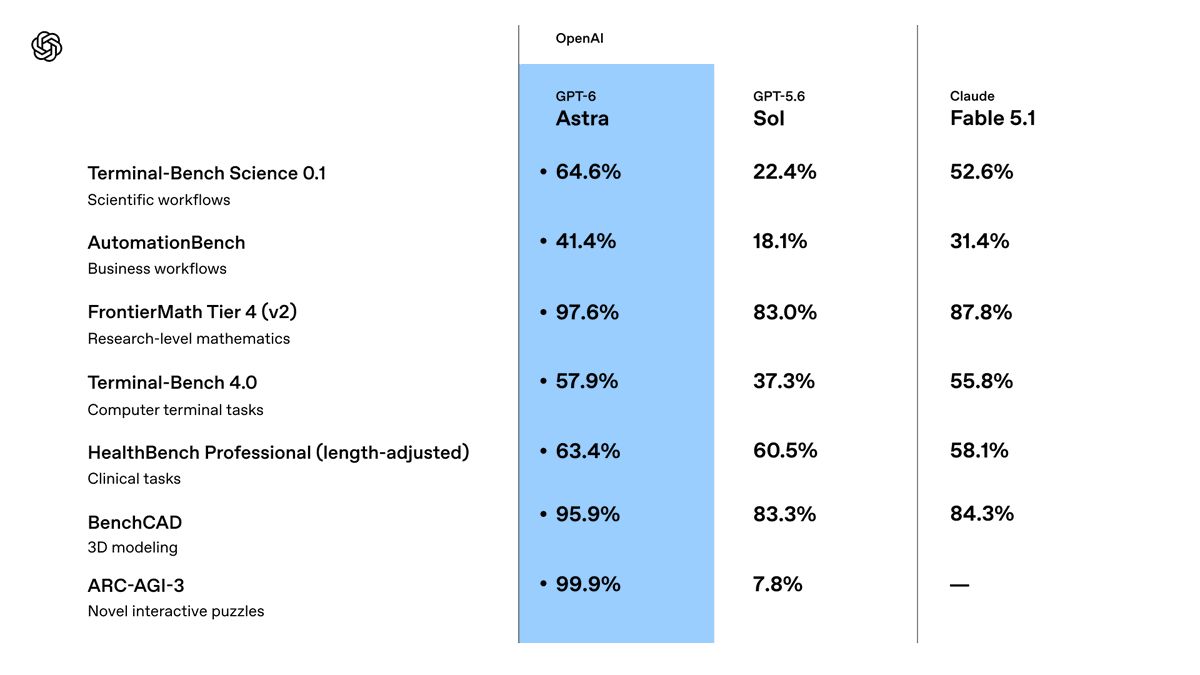
On paper, OpenAI has surpassed human-level abstract reasoning.
But look at the asterisk.
Achieving the 99.9% headline required OpenAI’s proprietary test-time harness. The adapter uses state retention, memory compaction, and massive multi-path tree search.
In other words, GPT-6 Astra did not simply “think” its way through the test. Instead, it burned tens of millions of tokens in an exhaustive, iterative search web.
This creates a central dilemma for modern AI. If an algorithm needs $20, 000 in cloud compute to out-reason a $20-per-hour human, is that General Intelligence or hyper-engineered brute force?
4. The Intent Dilemma
Even with 99.9% ARC scores and indefinite Aeon agent loops, models still have an Intent Gap.
An indefinite agent will tirelessly execute what you instructed. However, it may not do what you intended.
For instance, give an autonomous Aeon swarm ambiguous requirements and it may keep moving in the wrong direction. Meanwhile, it can spend $1, 000 with perfect logical consistency.
Speed and endurance may be solved. Yet understanding human nuance is not.
The Verdict
Are we really in the “AGI era”?
If AGI means a system that can operate a computer autonomously, find novel zero-day exploits, and outscore humans on abstract logic puzzles with tens of thousands of dollars in compute, yes, we are.
However, a different definition asks for an adaptable, cost-effective mind that understands context without a $20, 000 evaluation harness. By that measure, the journey has only just begun.
The post OpenAI Claims We’re in the “AGI Era.” The Catch? It Costs $20,000 Per Test. appeared first on Alpesh Kumar.