
LangGraph Multi-Agent Systems: Practical Tutorial Series
Quick summary
- Follow a progressive learning path: move from a stateful conversational agent to coordinated specialists.
- Add one capability at a time: the series covers supervisors, shared context, routing, persistence and evaluation.
- Make responsibilities explicit: separate planning, execution, data flow and recovery.
- Build for observability: favour understandable state and testable behaviour over adding more agents.
This LangGraph multi-agent systems tutorial series takes you from a single conversational agent to a reliable workflow of a supervisor and specialist agents. Each tutorial adds one practical capability: delegation, shared context, routing, recovery, or evaluation.
Who this series is for
This series is for Python developers who understand the basics of language models and want to move from one agent to a coordinated system of specialist agents. You should be comfortable reading Python, calling an LLM, and working with simple application state. You do not need to understand every LangGraph feature before starting.
Start with the foundations
Begin with Building Intelligent Conversational Agents with LangGraph. It introduces the stateful conversational-agent concepts that the multi-agent tutorials build on.
The tutorial path
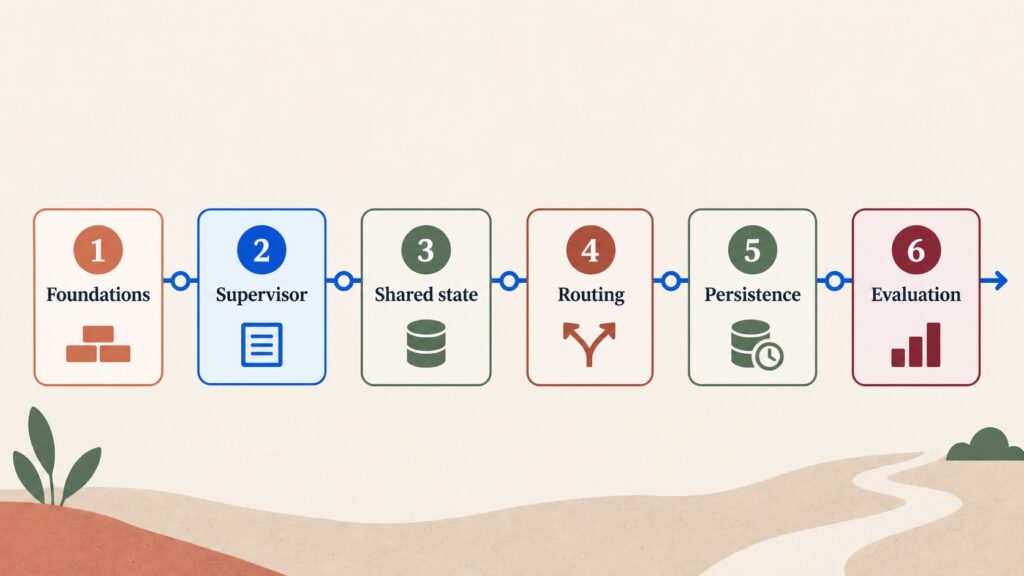
- Foundations: Build an intelligent conversational agent with LangGraph.
- Supervisor architecture: Build a supervisor-based multi-agent system with LangGraph.
- Shared state and context: Control what each agent receives, retains, and returns.
- Routing and parallel execution: Send tasks to the right agents and combine their results.
- Persistence and recovery: Add checkpoints, retries, and resumable workflows.
- Evaluation: Measure routing quality, tool use, reliability, cost, and latency.
How to use this series
Read the tutorials in order if you are new to LangGraph. If you already understand graph state, nodes, and edges, use the path above to jump to the architecture you need. Every tutorial links back to this guide, explains its prerequisites, and points to the next step.
What you will learn about LangGraph multi-agent systems
Across the series, you will develop a practical workflow made from a supervisor and specialist agents. The examples separate planning, execution, context management, recovery, and evaluation so that each responsibility can be understood and tested independently.
The emphasis is on explicit state, understandable routing, useful traces, and controlled failure handling – not on adding agents simply because a workflow can support them. The result is a system that is easier to explain, debug, and improve than an opaque collection of prompts.
Build one small LangGraph multi-agent systems project
Use the same modest project throughout the series so each new concept solves a visible problem. A hypothetical research assistant is a useful example: it receives a question, gathers permitted evidence and produces a short answer with sources. Begin with a single workflow that completes that task. Introduce specialists only when separate responsibilities make the behaviour easier to control or evaluate.
For instance, a researcher can return evidence, while a writer turns that evidence into an explanation. A supervisor decides which step should run next and when the work is complete. Define what each component receives and returns before writing elaborate prompts. A clear output contract prevents one agent from handing another a vague conversation that contains no usable result.
The official LangGraph overview describes a runtime for stateful orchestration, including durable execution and human involvement. These capabilities support the workflow, but they do not decide the application’s policies. You still need to specify which actions are allowed, what counts as success and how incomplete work should be reported.
Design state before adding more agents
Keep the original request, collected evidence, outstanding tasks and final answer distinct. This makes it possible to inspect the workflow without reading every intermediate message. It also reduces the risk of treating an agent’s tentative suggestion as a verified fact. Where provenance matters, preserve the source associated with each claim rather than relying on the writer to reconstruct it later.
Shared state needs clear ownership. Decide which node can update each field and how multiple updates combine. If two specialists run concurrently, their results should merge predictably instead of overwriting one another. A useful exercise is to run the same example with the specialists finishing in different orders and inspect whether the final evidence remains complete.
Keep private or irrelevant context out of specialist inputs. A writer may need approved research notes without needing every raw tool response. Explicit context boundaries make prompts shorter and make accidental dependencies easier to spot. They also help you explain why a particular component reached its answer.
Test LangGraph multi-agent systems at each milestone
After adding routing, test a request that needs one specialist and another that needs several. Include an ambiguous request and define whether the system should ask for clarification or return a bounded answer. Stop conditions deserve the same attention as routing conditions: an agent loop that keeps revising a satisfactory answer wastes time and can make the result worse.
When adding recovery, deliberately interrupt a harmless example. Check which state survives and whether restarting repeats work. A resumed workflow must not accidentally repeat an external action, such as sending a notification, simply because the earlier response was lost. Persistence records progress; safe retries require application-level decisions about repeated effects.
Finally, keep a small evaluation set that includes successful cases, missing evidence and tool failures. Inspect the route and intermediate results alongside the final prose. A persuasive answer can still be unsupported. Continue with the site’s LangGraph evaluation tutorial to turn those observations into a repeatable check. Move to the next lesson when you can explain the current workflow’s behaviour, including how it fails.
The post LangGraph Multi-Agent Systems: Practical Tutorial Series appeared first on Alpesh Kumar.