
I Compared Deep Agents Code with Claude Code. Here’s What Stands Out
In brief
- Deep Agents Code is a flexible, open-source coding harness. You can connect different model providers and choose how commands and files are handled.
- Claude Code is Anthropic’s coding agent, built around Claude models and a more integrated command-line workflow.
- The biggest practical difference is control: Deep Agents gives you more choices to configure; Claude Code gives you a more focused setup.
- Neither is automatically safer. Your setup, permissions, and review process still matter.
Deep Agents Code and Claude Code differ in more than the models they use. If you are choosing a coding agent, you also need to know where it can run commands, what it can access, and how much setup you are willing to manage.
This article compares their documented features, not hands-on performance. For more on Claude Code’s internals, see this architecture walkthrough.
Deep Agents Code vs Claude Code: the practical differences
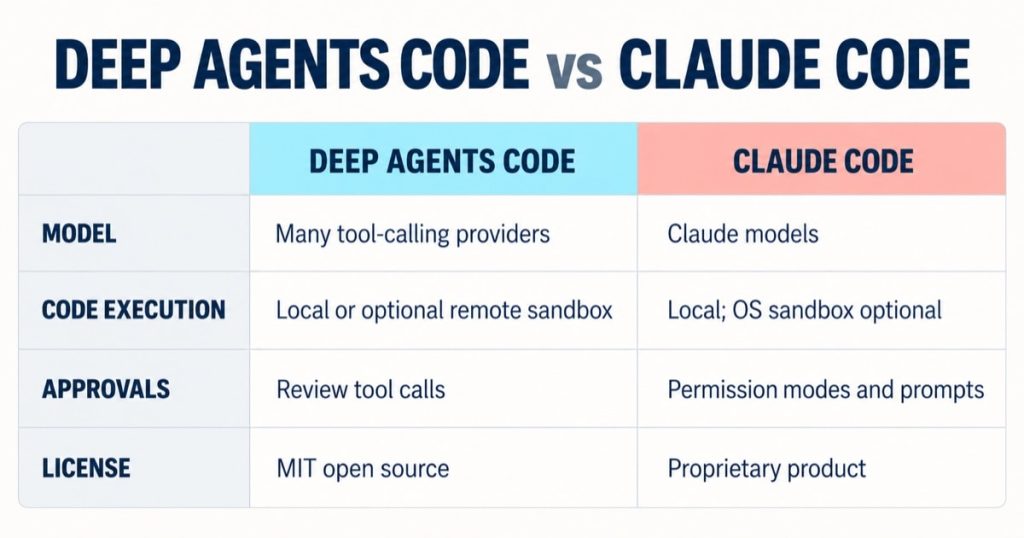
| What matters | Deep Agents Code | Claude Code |
|---|---|---|
| Best fit | People who want to configure an agent harness around their tools and model provider. | People who want a coding agent designed to work with Claude. |
| Models | Can connect to multiple providers, including hosted and local models, depending on configuration. | Uses Claude models through Anthropic and supported cloud platforms. |
| Command execution | Execution can use different backends, such as a local or virtual filesystem, or a remote sandbox. | Commands run within Claude Code’s environment and permission model. |
| Approvals | Lets you configure human approval around selected tool calls. | Provides permission controls for actions such as editing files and running commands. |
| Customisation | Offers a modular harness that developers can extend or adapt. | Offers a more integrated product experience with its own configuration and extension options. |
| Licence | The project is open source under the MIT licence. | Claude Code is a proprietary product. Its availability and usage depend on Anthropic’s terms. |
These categories describe different layers of the tools. Deep Agents Code is a framework you can shape around your environment. Claude Code is a ready-to-use agent product. That distinction affects setup effort as much as it affects features.
Where Deep Agents Code stands out
Deep Agents Code is appealing if you do not want your coding workflow tied to one model provider. A team can choose a hosted model, experiment with a local model, or change providers as its needs evolve, subject to the integrations it configures.
It also gives developers choices about execution. A local backend may suit a personal workflow, while a remote sandbox can help separate agent commands from a developer’s machine. The trade-off is that flexibility brings responsibility: someone has to select, configure, and maintain the pieces.
Where Claude Code stands out
Claude Code has a narrower centre of gravity: it is built around Claude. For someone already using Anthropic’s models, that can make the workflow easier to adopt. There are fewer provider choices to wire together, and the product’s command-line features and permissions are designed as one experience.
That focus also means less freedom to swap in an unrelated model provider. If model choice is a deciding factor, check the current supported options before committing to a workflow.
Deep Agents Code and Claude Code: approvals and sandboxes
An approval prompt asks whether an action should go ahead. A sandbox limits what the action can reach. They work together, but one does not replace the other.
- Approvals give a person a chance to review selected actions.
- Sandboxes can constrain access to files, networks, or command execution.
- Configuration determines which actions need approval and what boundaries apply.
So do not judge either tool’s safety from a feature list alone. Review the permission settings, execution environment, and access granted in your own setup.
Which one should you choose?
Choose Deep Agents Code if you want an open-source foundation, multiple model-provider options, or control over the execution backend. It is the more adaptable choice, especially for developers prepared to configure and operate the harness.
Choose Claude Code if you want a focused coding agent built around Claude and prefer an integrated workflow over assembling a configurable stack. It may be the simpler place to start if Claude is already your preferred model.
If you are unsure, decide based on these questions:
- Do you need to switch between model providers?
- Do you want to manage the execution environment yourself?
- Would you rather configure a flexible framework or start with an integrated tool?
What to check before using either tool
- Confirm which models and providers are supported by the version you plan to use.
- Understand where commands run and which files or services the agent can access.
- Review approval settings, then test the workflow on a project where mistakes are easy to undo.
The short version: Deep Agents Code offers more room to choose and configure; Claude Code offers a more focused path built around Claude. The right fit depends on whether you value flexibility or a more integrated starting point.
This comparison reflects published documentation and project information. It does not claim hands-on performance testing.
The post I Compared Deep Agents Code with Claude Code. Here’s What Stands Out appeared first on Alpesh Kumar.