
Should We Really Be Afraid of an Em Dash?
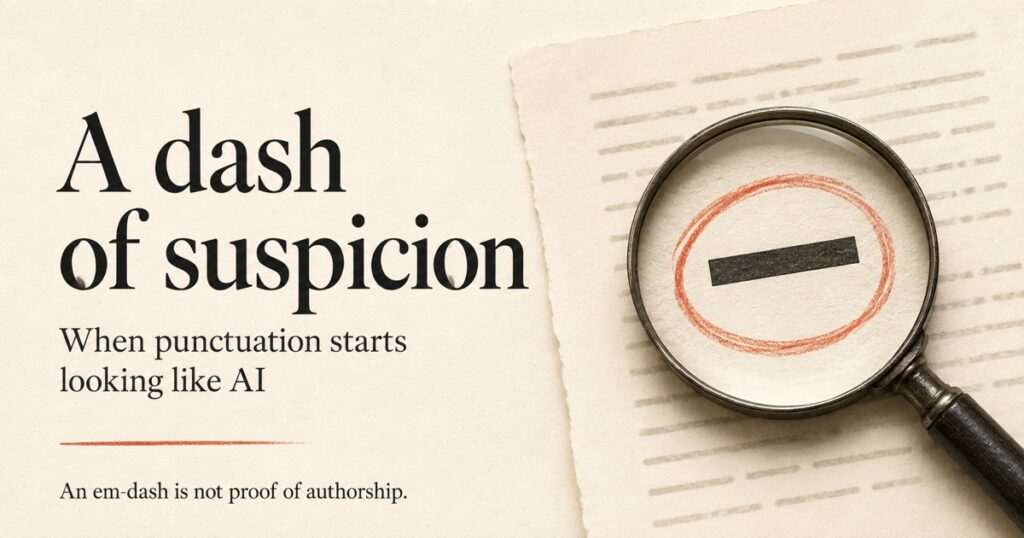
Quick summary
- Punctuation is not proof of authorship: a common AI-associated pattern cannot establish who wrote one article.
- Edit for clarity and rhythm: keep a dash when it helps and remove it when the sentence reads better without it.
- Separate trends from individual verdicts: population-level observations have limits as detection tools.
- Prioritise substance: assess sources, examples, useful advice and acknowledged limitations.
How the em dash became a reason to distrust writing, and what deserves our attention when we edit.
Imagine finishing a thoughtful post, reading it back, and making one last change.
You delete a dash.
The sentence worked perfectly well. You just don’t want someone in the comments saying, “Obviously written by AI.”
That small act captures something uncomfortable about writing online today. Alongside checking whether our words are clear, we are starting to check whether they look sufficiently human.
The em dash has become an unlikely focus of that anxiety.
Brent Csutoras’s account of trying to stop AI from using it raises a wider question: what happens to writing when an ordinary stylistic choice starts to look suspicious?
There is a real pattern behind the conversation. But turning that pattern into a verdict about an individual writer takes us much further than the evidence supports.
The em dash is the long mark in a sentence like this:
I was ready to publish – until I checked the source.
It creates a break, giving the second part a little more weight. A full stop would also work, but the rhythm would change.
That flexibility is precisely what makes it useful. The Chicago Manual of Style explains that dashes can substitute for several other punctuation marks, while warning that their versatility makes them easy to overuse. This is an editing concern that exists independently of AI. Chicago’s guidance
A dash can improve a sentence. A paragraph full of dramatic interruptions can become exhausting.
Readers eventually need somewhere to rest.
Why the em dash became associated with AI
In an August 2026 analysis of English-language webpages, Pew Research Center reported that em dashes appeared roughly twice as frequently as in its 2023 comparison. It also explained that language models learn stylistic patterns from human writing and may reproduce some features more often than people typically do. Pew Research Center’s analysis
That helps explain how the association developed. Readers encounter a pattern repeatedly, recognise it, and begin using it as a shortcut.
The shortcut becomes unreliable when “AI often does this” turns into “only AI does this”.
A 2026 preprint examining 69,632 medRxiv papers found an increase in em-dash use in Discussion sections after the arrival of ChatGPT. Crucially, the author describes this as a population-level indicator, says it cannot identify AI use in an individual paper, and notes that the study cannot establish causality. Read the research abstract
That distinction matters. A change across thousands of documents can tell us something about writing trends without telling us who wrote the paragraph in front of us.
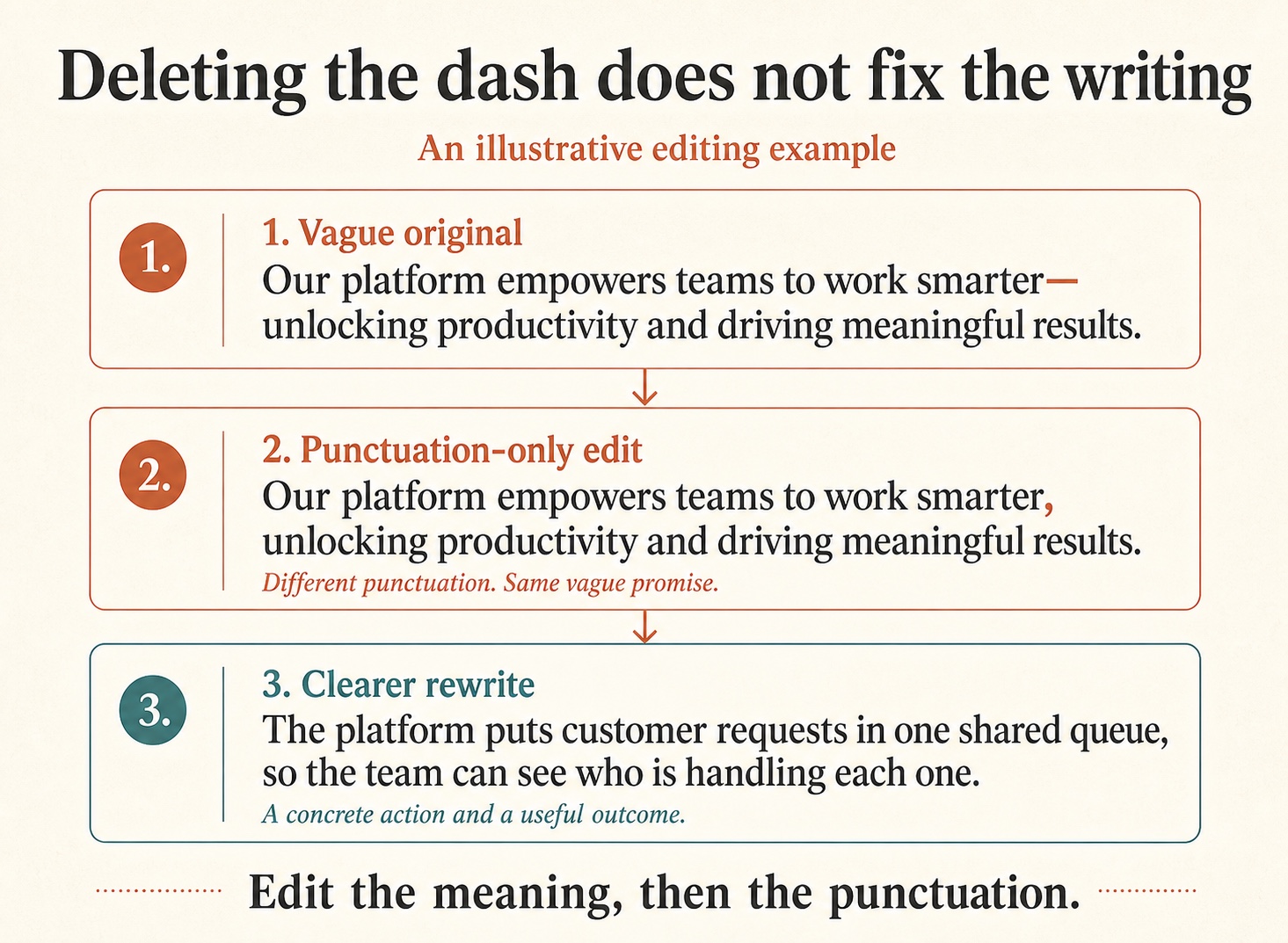
Deleting the dash can leave the real problem untouched
Consider this invented sentence:
Our platform empowers teams to work smarter – unlocking productivity and driving meaningful results.
Now remove the dash:
Our platform empowers teams to work smarter, unlocking productivity and driving meaningful results.
The punctuation has changed. The reader still has no idea what the product does.
A more useful version might be:
The platform puts customer requests in one shared queue, so the team can see who is handling each one.
That revision gives the reader something they can understand and assess.
This is where editing effort pays off. Look for sentences that sound confident but contain very little information. Ask what happened, how something works, who benefits, and what evidence supports the claim.
A page can contain no em dashes and still be vague, repetitive or wrong. A carefully researched essay can contain several and be excellent.
Give each punctuation mark a job
If a draft feels crowded with dashes, review the relationship between the ideas before replacing anything.
A full stop helps when both statements deserve their own space:
The trial has ended. We will publish the results on Friday.
A colon works when the second part explains the first:
One issue remains: the export fails on large files.
Parentheses suit a supporting detail that can sit quietly inside the sentence:
The workshop (recorded last Thursday) is now available.
An em dash can earn its place when the interruption matters:
The backup worked – just not the one we had been testing.
These choices affect emphasis. Automatically replacing every dash with a comma can introduce grammatical problems or make the sentence harder to follow.
The useful question is simple: what should the reader notice here?
Better AI-assisted writing starts with better material
If you use AI to help draft, give it your actual points, the intended audience and the evidence you want to include. A short sample of your own writing can also make your preferences clearer.
Then ask for an editing pass with a specific purpose:
Revise this draft for clarity. Preserve my meaning and factual claims. Flag vague statements and unsupported claims. Do not invent examples, results or personal experiences. Review each em dash and keep it only where the interruption improves the sentence.
That instruction gives you a more useful task to review than a general request to “make it sound human”.
Afterwards, read the result yourself. Check the sources. Replace language you would never use. Remove sentences that repeat a point without developing it. If a claim needs evidence you do not have, narrow it or leave it out.
Avoid adding deliberate mistakes as proof of authenticity. They give the reader more work without making the argument more trustworthy.
Readers deserve a better test, too
When something feels suspiciously polished, examine its substance.
Does the source support the claim? Does the example explain anything? Has the writer acknowledged an important limitation? Could the advice actually help someone make a decision?
These questions help assess writing regardless of how it was produced. When authorship itself matters, punctuation alone cannot settle it. Pew likewise cautions that individual documents can be misclassified and that familiar stylistic features do not establish AI authorship. Pew’s explanation of detection limits
For a broader look at evidence about where content comes from, see AI Watermarks Are Not a Silver Bullet: What Provenance Signals Can and Cannot Prove.
A more useful standard is the care a writer takes with the reader’s time and trust.
Keep the dash when it helps. Remove it when the sentence reads better without it. Then spend the attention you saved checking whether you have said something worth reading.
The post Should We Really Be Afraid of an Em Dash? appeared first on Alpesh Kumar.