
The Collatz Conjecture: The Simple Rule No One Can Prove
Choose any positive whole number. If it is even, divide it by 2. If it is odd, multiply it by 3 and add 1. Then repeat. This is the Collatz conjecture, one of mathematics’ most famous open problems.
The rule can be followed with a calculator, a spreadsheet, or a few lines of code. Yet nobody has proved that it works for every positive integer. That gap between an observed pattern and a universal guarantee is what makes this tiny puzzle so compelling.
Understanding the Collatz conjecture rule
For a positive integer n, the next value is n / 2 when n is even, and 3n + 1 when n is odd. The conjecture says repeated application eventually reaches 1 for every positive integer. If the process continues after 1, it enters the loop 1 → 4 → 2 → 1.
Starting from 3 gives a complete short path:
3 → 10 → 5 → 16 → 8 → 4 → 2 → 1
Starting from 6 shows why the two cases cannot be considered separately:
6 → 3 → 10 → 5 → 16 → 8 → 4 → 2 → 1
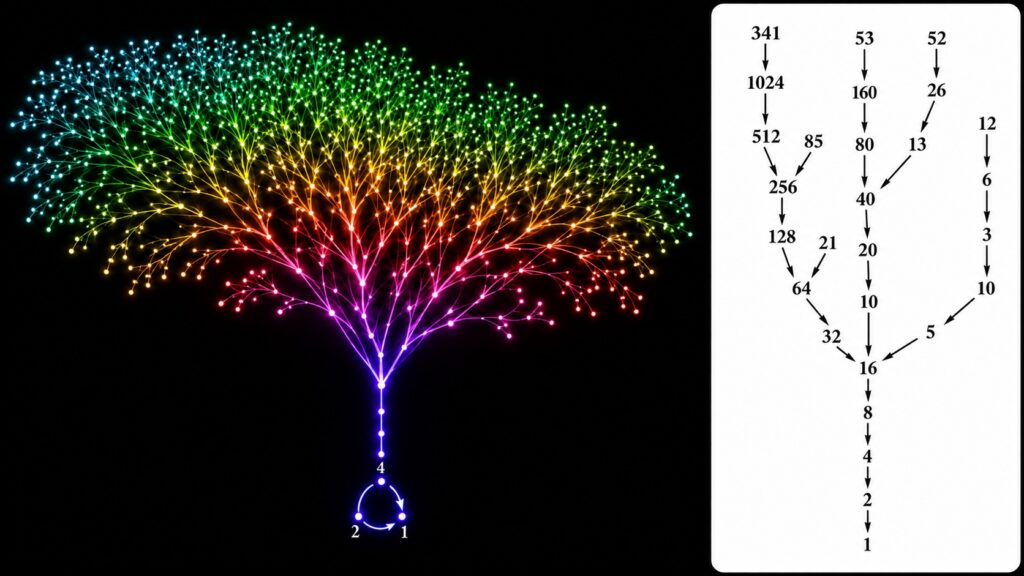
The standard presentation of the problem is given in Jeffrey Lagarias’ overview of the 3x+1 problem. It is also called the Syracuse problem, Hasse’s algorithm, Kakutani’s problem, and the Ulam problem.
Why 27 is the example everyone remembers
Using the standard rule, the path from 27 begins:
27 → 82 → 41 → 124 → 62 → 31 → 94 → 47 → 142 → …
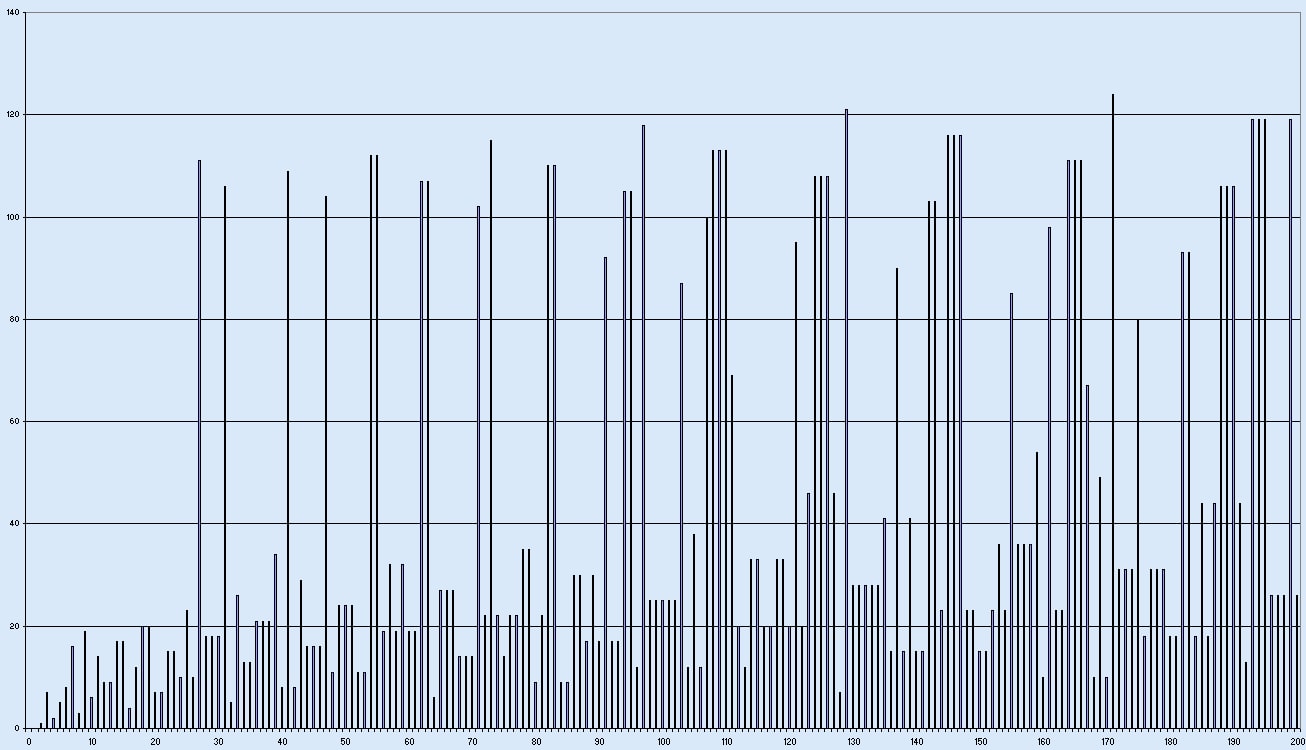
It does reach 1, but only after 111 transformations. Along the way it climbs from 27 to a maximum of 9,232. That rise is the important part of the example. A rule that looks as though it should make numbers smaller can instead generate a long, surprising detour.
There is a convention worth separating here. Some papers use an accelerated map that combines an odd step with a subsequent division by 2. It represents the same conjecture, but it changes the displayed path and can change quoted maxima and step counts. Under that convention, the corresponding 27 peak is 4,616. In this article, all examples use the unaccelerated rule stated above.
What a Collatz conjecture proof would need to show
A calculation can show that a particular start reaches 1. It can also show that every start in a specified finite interval reaches 1. Neither result proves the Collatz conjecture, because the claim is about every positive integer and there are infinitely many of them.
This is a useful distinction beyond mathematics. A large test suite can build strong confidence that a system behaves correctly for covered inputs. It does not automatically establish behaviour for every state, timing condition, or interaction. The same issue appears in AI agent evaluation: a successful result matters, but it does not by itself explain or guarantee the whole route that produced it.
What computers have verified
Computation has made the evidence remarkably strong. David Bařina’s public project reports that every starting value below approximately 271.02, or 2,075 × 260, has been verified to converge to the cycle through 1. That is about 2.45 sextillion starting values. The project also publishes its progress and references to its verification work. See the verification record.
This is extraordinary evidence, but it remains a finite calculation. A counterexample, if one exists, could still occur above the verified range.
Why the Collatz conjecture is hard to prove
There is an appealing heuristic. Even values halve. An odd value becomes 3n + 1, which is even and must then be halved at least once. If the pattern of odd and even steps behaved sufficiently like random coin flips, the divisions by 2 would tend to win in the long run.
However, that is only intuition. The parity pattern is not generated by independent coin flips. It is produced by the number itself. A proof must eliminate every exceptional path, including one with a rare and highly structured sequence of odd and even values. Lagarias describes the challenge as understanding the apparently pseudorandom successive iterates of the map.
Collatz conjecture research: a major partial result
In 2019, Terence Tao proved a substantial partial result. In a precise logarithmic-density sense, almost all Collatz orbits eventually fall below any chosen function that tends to infinity, however slowly that function grows.
“Almost all” is doing important work here. It does not mean all starting values, and it does not prove that every path reaches 1. It says that any exceptional set is sparse in a technical logarithmic-density sense. A single exception would still disprove the conjecture. Tao’s paper gives the formal statement, while the Institute for Advanced Study summary provides accessible context.
How could the conjecture fail?
A positive counterexample would have to avoid the 1 → 4 → 2 loop. It might do so by diverging indefinitely, by entering a different cycle, or by exhibiting some other non-converging behaviour. No positive example of any of these is known. Researchers have established strong constraints on possible non-trivial cycles, but no argument rules out every one.
How to experiment responsibly
The problem makes an excellent small programming exercise. Record each term for a chosen start, count the transformations needed to reach 1, and record the largest value reached. Then state exactly what the experiment supports.
For example, after checking every start from 1 to 1,000, the sound conclusion is: “Every tested number from 1 to 1,000 reached 1.” The unsound conclusion is: “Every positive integer reaches 1.” That boundary is the lasting lesson of the Collatz conjecture. Experiments reveal patterns and edge cases. A proof provides the guarantee that remains when no further input can be tested.
Sources and further reading
- Jeffrey C. Lagarias, The 3x+1 Problem: An Overview.
- Terence Tao, Almost all orbits of the Collatz map attain almost bounded values.
- David Bařina, Convergence verification of the Collatz problem.
The post The Collatz Conjecture: The Simple Rule No One Can Prove appeared first on Alpesh Kumar.