
Games with Astra: How AI Is Changing Game Development
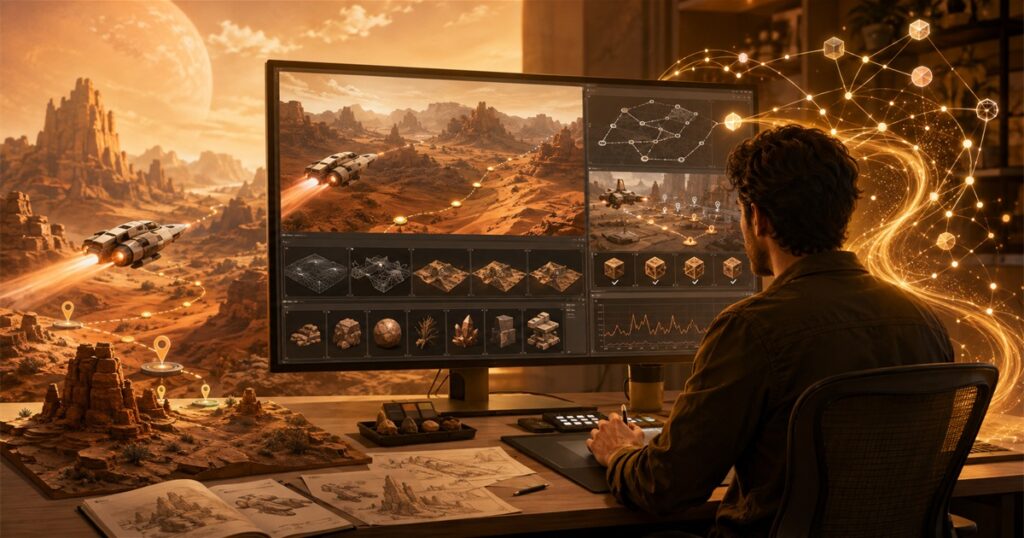
I have been following the rapid progress of AI-assisted software development, and games with Astra caught my attention because they show a different side of what coding agents can do. OpenAI’s recent developer post demonstrates how an AI coding agent can work across architecture, rendering, testing, assets, and optimisation rather than simply generating isolated code.
What makes this interesting to me is not the idea that AI can “build a game” by itself. The more useful lesson is how a developer can give an agent clear goals, constraints, feedback, and tests, then let it handle much of the implementation while the developer remains responsible for the product.
Start with the player experience
One of the strongest ideas in games with Astra is to start with the experience instead of a technology checklist. The example game, Void Explorer, is built around a continuous journey from space to a planet’s surface.
That requirement creates several technical challenges. The game needs procedural terrain, large-scale coordinates, smooth transitions, multiple levels of detail, and responsive controls. Instead of treating each problem as a separate feature, the development process connects them to the experience the player should have.
I think this is useful beyond gaming. First, define what the user should be able to do. Then choose the architecture and implementation that support that outcome.
AI-assisted architecture
Astra proposed an architecture using TypeScript, Vite, and Three.js. Later, the rendering approach moved towards WebGPU while keeping the core simulation and navigation systems.
This is where games with Astra become particularly interesting for developers. The value is not simply code generation. An agent can review an existing implementation, identify a bottleneck, suggest another approach, and help implement and test the change.
For experienced developers, that can make the workflow more collaborative. I can imagine using the same pattern in web applications, APIs, data pipelines, or machine learning systems: define constraints, let the agent explore an implementation, review the result, and iterate.
Testing still matters
AI-generated code does not remove the need for testing. In fact, complex interactive systems make testing even more important.
The OpenAI example uses repeatable test scenes and browser checks for actions such as landing, leaving the ship, walking, saving, reloading, boarding, and taking off. This gives the agent a way to reproduce problems instead of relying only on visual inspection.
For me, this is one of the most important lessons from the article. A coding agent becomes much more useful when it has reliable feedback. Tests, logs, performance counters, screenshots, and measurable outcomes give it evidence about whether a change actually worked.
Procedural worlds and performance
The game also shows why procedural generation needs careful engineering. Thousands of planets do not need thousands of fully detailed meshes loaded at once. Instead, the world can be represented using compact descriptions and generated around the area the player is approaching.
The renderer uses multiple levels of detail. Distant planets remain inexpensive, while nearby terrain becomes progressively more detailed. This is a familiar optimisation principle. However, the interesting part is how an AI coding agent can help investigate these bottlenecks and compare controlled measurements.
One example in the OpenAI post reports a major reduction in discarded terrain-generation jobs after the scheduling logic was changed. The important point is not that every project will see the same result. Instead, an agent can help connect a gameplay problem to a measurable engineering problem.
From concept to game assets
Another part I found interesting is the connection between image generation, Blender, and game development. Concept images were used to establish the visual direction, while the player ship was then developed as a proper 3D asset.
This suggests a broader workflow. Instead of keeping design, modelling, programming, and testing completely separate, AI tools can help connect the stages.
However, human review remains important. Technically correct does not always mean visually right or enjoyable to play.
What developers can learn from games with Astra
For me, games with Astra are less about replacing game developers and more about changing how developers spend their time. An agent can handle repetitive implementation, investigate code paths, run tests, and propose optimisations. Meanwhile, the developer can focus more on product decisions, architecture, user experience, and quality.
There is also a warning. Faster implementation can create technical debt faster. Therefore, clear project structure, tests, version control, security checks, and human review still matter. AI should increase engineering leverage, not remove engineering discipline.
I am especially interested in how this approach could move beyond games. The same development loop — describe the outcome, establish constraints, build, test, measure, and iterate, can apply to many modern software projects.
Conclusion
The most useful takeaway from games with Astra is not simply that an AI agent can produce an impressive demo. It is that AI-assisted development is becoming more capable of working across an entire engineering workflow.
As a developer, I see this as a shift from “AI writes code” to “AI participates in the development process.” That difference matters. The strongest results will still come from combining capable AI tools with clear requirements, good architecture, repeatable tests, and experienced human judgement.
For developers exploring this area, the original OpenAI Developers article is a useful technical reference.
The post Games with Astra: How AI Is Changing Game Development appeared first on Alpesh Kumar.