
Clean Architecture and the Command Bus: When It Helps and When It Adds Complexity
In brief: A Command Bus can route an application command to its handler and provide a shared pipeline for behaviors such as logging or validation. It can reduce the number of handler dependencies a controller declares, but it does not remove those dependencies or make an application “clean” by itself. In Clean Architecture, treat the bus as an outer application boundary, keep domain rules independent of it, and use it when the dispatch or pipeline solves a real problem.
An order controller often begins with one useful job: translate an HTTP request into an application action. As the feature set grows, the constructor can accumulate a handler for every endpoint. That is a signal to review the design, but it does not automatically mean the controller needs a Command Bus.
What Clean Architecture asks you to protect
Clean Architecture is about boundaries and dependency direction. User-interface and infrastructure details should depend on application policies, while domain rules should not depend on web frameworks, databases, or mediator libraries. A Command Bus is a way to dispatch work across an application boundary. It is not the boundary itself, and it is not a required Clean Architecture component.
For a broader view of how Clean Architecture relates to domain design and event-driven systems, see our guide to Clean Architecture, SOLID, DDD, and event-driven systems.
Why controller constructors grow
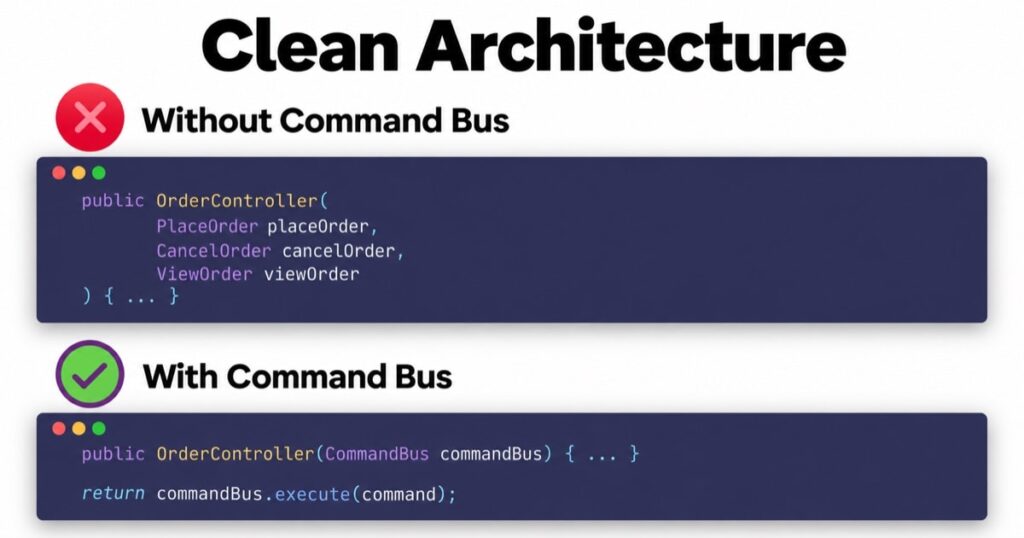
Suppose an order API supports placing, cancelling, and viewing orders. With direct injection, a controller can name each collaborator it uses:
public class OrderController {
    private final PlaceOrder placeOrder;
    private final CancelOrder cancelOrder;
    private final ViewOrder viewOrder;

    public OrderController(
            PlaceOrder placeOrder,
            CancelOrder cancelOrder,
            ViewOrder viewOrder) {
        this.placeOrder = placeOrder;
        this.cancelOrder = cancelOrder;
        this.viewOrder = viewOrder;
    }
}
This is explicit and easy to follow. Each dependency can be replaced in a test, and a reader can see the controller’s collaborators. A long list may point to a controller with too many responsibilities, though. Splitting endpoints into smaller controllers or organizing application operations by feature may solve the problem without adding a dispatcher.
How a Command Bus changes the call path
A command represents an intention to change state, such as PlaceOrder. A command handler performs the application workflow for that intention. The bus receives the command and selects the matching handler:
HTTP request
    → Controller
    → Command Bus
    → PlaceOrderHandler
    → application and domain logic
The following minimal contracts show what the examples mean by a command, handler, and bus. A real dispatcher still needs a handler registry and clear behavior for missing or duplicate registrations.
public interface Command<R> {
}

public interface CommandHandler<C extends Command<R>, R> {
    R handle(C command);
}

public interface CommandBus {
    <R> R dispatch(Command<R> command);
}
The controller now depends on a single dispatch interface:
@RestController
public class OrderController {
    private final CommandBus commandBus;

    public OrderController(CommandBus commandBus) {
        this.commandBus = commandBus;
    }

    @PostMapping("/orders")
    public ResponseEntity<OrderReceipt> placeOrder(
            @RequestBody PlaceOrderRequest request) {
        PlaceOrder command = new PlaceOrder(
                request.customerId(),
                request.items());

        return ResponseEntity.ok(commandBus.dispatch(command));
    }
}
The important step is mapping the transport DTO to an application command. Passing an HTTP request object straight through can couple the application layer to the web layer. Keep that direction of dependency visible, especially when the command and request have different validation or versioning needs.
The record syntax below requires Java 16 or later. Repository and domain types are application-specific examples.
A typical command and handler might look like this:
public record PlaceOrder(
        UUID customerId,
        List<OrderLine> items
) implements Command<OrderReceipt> {
}

@Service
public class PlaceOrderHandler
        implements CommandHandler<PlaceOrder, OrderReceipt> {

    private final OrderRepository orders;
    private final CustomerRepository customers;

    public PlaceOrderHandler(
            OrderRepository orders,
            CustomerRepository customers) {
        this.orders = orders;
        this.customers = customers;
    }

    @Transactional
    public OrderReceipt handle(PlaceOrder command) {
        Customer customer = customers.getRequired(command.customerId());
        Order order = Order.place(customer, command.items());
        orders.save(order);
        return new OrderReceipt(order.id());
    }
}
The application-specific types in this example stand in for your own domain model and repository interfaces. A mediator library or a small registry can resolve the handler. Keep that dispatch machinery at the application boundary; the domain model should not need to know that a bus exists.
Where Command Bus pipeline behaviors fit
Some mediator implementations let you wrap handler execution in a pipeline. That gives shared technical behavior one path through the application:
- Logging and tracing: record the command type, duration, and outcome without duplicating instrumentation in every handler.
- Validation: run command-specific input validators before the handler.
- Transactions: define a transaction boundary when it matches the use case’s consistency requirements.
- Error translation: map application failures into a consistent response at the appropriate outer boundary.
These are options, not automatic benefits. Logging may apply broadly, while authorization and transactions often depend on the operation. Spring Security supports request-level authorization and method-level authorization, so web access policy should remain deliberate rather than being moved wholesale into a generic bus behavior. Likewise, Spring’s @Transactional works through transaction infrastructure around method calls; annotating a handler can be a clear choice when the transaction belongs to that use case. See the Spring transaction reference and Spring Security authorization guide.
Choose one place for each behavior and document its scope. If a transaction is started by a pipeline and also by a handler, understand the transaction propagation and rollback rules. If validation is split between the HTTP boundary, the command, and the domain, make the responsibility of each check clear.
Command Bus trade-offs to account for
| Design choice | What improves | What you take on |
|---|---|---|
| Direct handler injection | Dependencies are visible at the controller | Controllers can accumulate collaborators if they own too many operations |
| Command Bus | Dispatch and shared pipeline behaviors have one entry point | Handler selection becomes indirect and registration errors can appear at runtime |
| Message broker | Can support communication across processes and durable delivery when configured | Requires delivery, retry, ordering, idempotency, and consistency decisions |
An in-process Command Bus is not a message broker. It does not persist commands or resume work after a process crash. For example, Spring Modulith’s event publication registry records transactional event publications and tracks listener completion. Those reliability features come from that additional infrastructure, not from a plain dispatcher. Read the Spring Modulith event documentation for its specific event workflow.
Command handling also does not require full CQRS. If your application uses one model for reading and writing, you can still represent state-changing actions as commands. Fowler’s CQRS overview explains why separating read and write models adds complexity and should be justified by the domain or system’s needs.
When a Command Bus is a good fit
Consider a Command Bus when several concrete needs meet: commands already represent meaningful application operations, the dispatch path is shared by multiple entry points, or pipeline behaviors remove repeated code without hiding important business rules. It can be useful when an HTTP controller, a scheduled job, and a message consumer all need to invoke the same application use case.
Prefer direct injection or a small application service when the number of operations is modest, the dependencies remain understandable, and a bus would only forward calls. If a controller has too many unrelated responsibilities, split it by feature first. A short constructor alone is not evidence that the architecture improved.
A practical rule for Clean Architecture
Keep the direction of dependencies clear: outer adapters translate input, application handlers coordinate a use case, and domain rules remain independent of delivery and dispatch details. Put shared technical behaviors at a boundary where their scope is explicit. Add a Command Bus when it makes that path easier to change, test, and understand.
The right question is not “Does Clean Architecture require a bus?” It does not. Ask instead: “Does this dispatcher solve a real coupling or pipeline problem in this application, and can the team still trace a command to its handler?” If the answer is yes, it may be a useful tool. If not, explicit dependencies are already a clean design.