
The Claude Code Playbook: 10 Power-User Systems That Ship
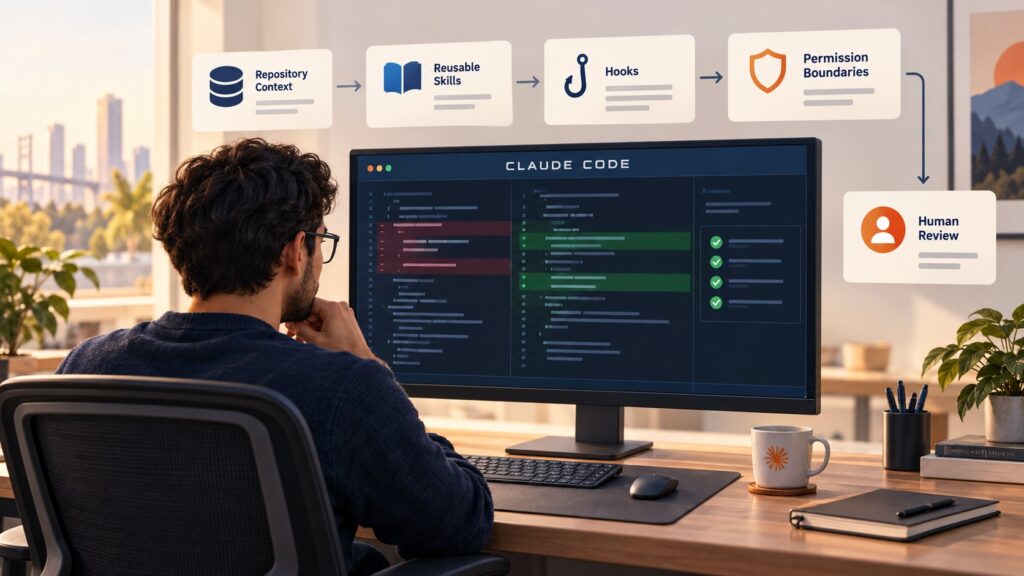
Claude Code can read your repository, change files, run commands, and connect to external tools. Yet many developers still begin every task from scratch and manually carry each decision from prompt to pull request. This Claude Code playbook shows how to build a system around the session, so useful context, repeatable work, and quality checks carry forward.
The goal is not to install every feature or run a swarm of agents. It is to make the path from a clear task to a verified change repeatable. We will set up repository context, an explore-to-verify loop, skills, hooks, subagents, MCP boundaries, and a measurement habit. Adopt the pieces that solve a real problem in your codebase.
Every code sample here is a hypothetical template. Replace commands, paths, and rules with your own repository conventions.
Why a Claude Code playbook needs more than better prompts
A prompt can improve one response. A workflow can improve every similar task that follows. If Claude repeatedly misses the test command, save the command in project guidance. If a release procedure needs the same six steps each time, turn it into a reusable skill. If formatting must happen after every edit, automate it with a hook.
Do not confuse activity with productivity. More generated code, open sessions, or tool calls does not prove that useful software shipped. Look at the whole delivery path: time to a reviewable change, rework, defects, and whether the expected checks passed.
Research offers no universal speed guarantee. Microsoft Research reported a 26.08% increase in completed tasks in field experiments involving 4,867 developers using an AI coding assistant. METR’s randomized study of 16 experienced open-source developers, using tools available in early 2025, found the developers took 19% longer on selected real tasks. A 2026 observational preprint found an association between Claude Code adoption and more commits, repositories, and languages, but its authors cautioned that the data cannot establish causality. Different tools, users, and tasks produced different findings. Use them as a reason to measure your own work, not as a promise about what your team will achieve.
1. Start your Claude Code playbook with a codebase map
Give Claude durable facts about the repository: how to run tests, where business logic belongs, which files are generated, and what compatibility rules matter. Start from the repository root so it can discover project instructions and code in context.
For each new task, state the outcome, constraints, scope, and success criteria. Then ask Claude to inspect before editing:
Goal: Add a configurable retry limit to webhook delivery.
Constraints: Preserve today's default and public response format.
Inspect first: Find the delivery path, configuration convention, and tests.
Do not edit yet. Summarize current behavior and flag assumptions.
Success: Test the default, configured limit, and retry exhaustion.
This short discovery step catches a mistaken assumption before it spreads into implementation. Anthropic’s documentation recommends starting with CLAUDE.md for project conventions and adding other extensions as a recurring need appears. Keep the file focused on information Claude needs across tasks. Move occasional reference material into skills that load when relevant. The current Claude Code extensions guide explains the distinction.
2. Put an explore, plan, build, verify loop at the center
For non-trivial changes, separate understanding from editing. Ask Claude to find the relevant code, describe the current behavior, identify affected tests, and outline a plan. Review the plan before implementation when the task crosses layers or could break a contract.
Then keep the change coherent and verify it in steps:
- Explore: trace the current implementation and its callers.
- Plan: list likely files, tests, and compatibility risks.
- Build: implement one focused change.
- Verify: run the narrowest useful tests, then wider checks when needed.
- Review: inspect the diff and ask for an exact report of commands and outcomes.
For the retry-limit example, checking that a new setting exists does not prove the feature works. Test the default, a configured value, the exhaustion path, and the existing response contract. Anthropic’s Claude Code best-practices guide describes an explore, plan, code, and commit workflow and recommends using subagents for focused early investigation on complex tasks.
3. Keep every instruction in the right place
One giant CLAUDE.md is not a power-user setup. It can burden every session with details relevant to only one kind of task. Put instructions where they are useful:
- CLAUDE.md: short project-wide facts and rules needed in most sessions.
- Path-scoped rules: local guidance for a package, language, or part of a monorepo.
- Skills: domain knowledge and repeatable procedures loaded on demand.
- Hooks: actions that should execute reliably on matching events.
A useful CLAUDE.md might say:
# Project guidance
- Run composer test for PHP changes and npm run lint for frontend changes.
- Keep controllers thin; business rules belong in services.
- Do not edit build/ output; regenerate it with npm run build.
- Preserve the REST response shape unless the task changes it.
Keep the always-loaded file brief and remove rules that no longer apply. Anthropic’s extensions guide describes CLAUDE.md as persistent context, skills as reusable on-demand knowledge, subagents as isolated workers, MCP as external connections, and hooks as event-driven automation. Each mechanism has a different job and context cost.
4. Turn repeated instructions into Claude Code skills
When you catch yourself pasting the same checklist into chat, save it as a skill. A skill can teach Claude when the procedure applies, what input to gather, which steps to follow, and what evidence to return.
Good examples include a release checklist, database-migration review, production-incident triage, or API-convention reference. A hypothetical review skill might ask Claude to compare the diff with the target branch, trace changed methods into their callers, run focused tests, and report findings with file locations and impact.
Test a new skill on examples where it should trigger and examples where it should not. If it misses relevant work, improve the description. If it triggers too broadly, narrow the scope. The official skills documentation covers creating and organizing skills.
5. Use hooks for checks that must happen every time
Skills guide reasoning. Hooks run commands, requests, or other actions at configured Claude Code lifecycle events. Use a hook when a specific action must happen consistently, such as formatting after file edits or blocking a forbidden operation.
Start with a fast check that is safe to repeat. Keep slower integration tests as explicit verification steps if running them after every edit would waste time. Review the hook’s command and permissions like any other code. A hook that runs an unsafe command more reliably is not a quality improvement.
Do not claim that automation proves the feature is correct. A formatter checks presentation. A type checker catches certain classes of mismatch. Tests provide evidence for the cases they cover. Human review still matters for architecture, product behavior, and security. Anthropic’s hooks reference describes supported events and configuration.
6. Delegate investigation before you split implementation
Subagents can read broadly in an isolated context and return a summary, which helps when exploration would otherwise fill the main session with tool output. Start with bounded research questions such as “trace how this endpoint checks permissions” or “find all tests that exercise retry exhaustion.”
Only parallelize implementation after you know the work is separable. Name the files or subsystem each worker owns, the expected result, and how it should verify its work. If two workers edit the same service, they may create conflicting assumptions even when each patch looks reasonable alone.
Use isolated worktrees or branches where appropriate, and keep an integration owner responsible for reconciling changes, running cross-component tests, and reviewing the combined diff. Limit concurrency to what you can inspect. Anthropic’s subagent documentation describes their isolated contexts and intended uses.
Delegation can widen the investigation, but a person still needs to integrate and review the result. Photo: Calqui, via Wikimedia Commons, CC BY-SA 3.0.
7. Make permissions part of the playbook
Claude Code can edit files and run commands, so configure access for the repository and task. Prefer narrow permissions and available sandboxing that fit the environment. Destructive operations, production systems, credentials, and external side effects need deliberate boundaries.
Retrieved content can also be hostile or misleading. A file, issue, or web page may contain text that tries to redirect the agent. Treat that material as data, not authority. Keep secrets out of prompts and logs, review commands before granting access, and consult the current Claude Code security guidance before changing permission settings.
8. Connect MCP to solve a real information gap
MCP connects Claude Code to external tools and services such as an issue tracker, database, or design system. Use it when it removes a repeated handoff or supplies evidence the task needs. Before connecting, check what a server can read, what it can change, and which credentials it uses.
For example, an issue-tracker connection might read acceptance criteria while leaving ticket edits, deployments, and production data writes unavailable. Pair the connection with a skill that explains how your team should use the tool. The MCP documentation covers server setup and access configuration.
9. Convert each task into a better next session
After completing work, capture only lessons likely to recur. If Claude could not find the test command, document it. If a review checklist helped repeatedly, make a skill. If a hook produced too much noise, change its trigger or output. If a correction applies only to one feature, leave it in the task rather than adding it to project-wide memory.
This feedback loop is how a setup improves without becoming a dump of old instructions. Keep the durable rules small, useful, and easy to update.
10. Measure the workflow instead of trusting the hype
Choose a small set of delivery measures: time to a reviewable change, review rounds, follow-up fixes, and whether the expected checks passed. Compare similar tasks with similar levels of risk. Do not compare a cross-service migration with a one-line config change.
Set a baseline, change one part of the workflow, and observe several tasks. If parallel agents save implementation time but double integration time, reduce the split. If a hook catches a recurring error with little delay, keep it. Remove a skill that never triggers or saves no effort.
For team-level evaluation beyond a single coding session, see our guide to evaluating AI agents in production and our article on building an evaluation flywheel.
Your first Claude Code playbook upgrade
Choose one task your team repeats. Write a concise task brief, ask Claude to inspect before editing, and decide what evidence will show the behavior works. Run that process a few times before adding more machinery.
Then make one durable improvement: a focused CLAUDE.md for project facts, a skill for repeated steps, a hook for a check that must always run, or a read-only subagent for broad investigation. Connect MCP only when a real information gap warrants its access. Track time and rework across comparable work.
The point is not to make Claude Code look busy. It is to make the route from request to reviewable change easier to repeat and safer to trust.
Sources and further reading
- Claude Code documentation: extend Claude Code
- Anthropic: Claude Code best practices
- Claude Code skills documentation
- Claude Code subagents documentation
- Claude Code hooks reference
- Claude Code MCP documentation
- Claude Code security documentation
- Microsoft Research: Field experiments with software developers
- METR: Randomized study of AI tools with experienced developers
- Observational preprint on Claude Code adoption