
Has Claude 3 Ushered in a New Era by Surpassing GPT-4?
Quick summary
- The article compares Claude 3 with GPT-4: it discusses capability claims and competition between model providers.
- Distinguish claims from practical fit: reported demonstrations do not replace evaluation on your own tasks.
- Stay adaptable: the article encourages developers to assess new models as the landscape changes.
- Choose for the use case: a model’s particular strengths matter more than a broad winner label.
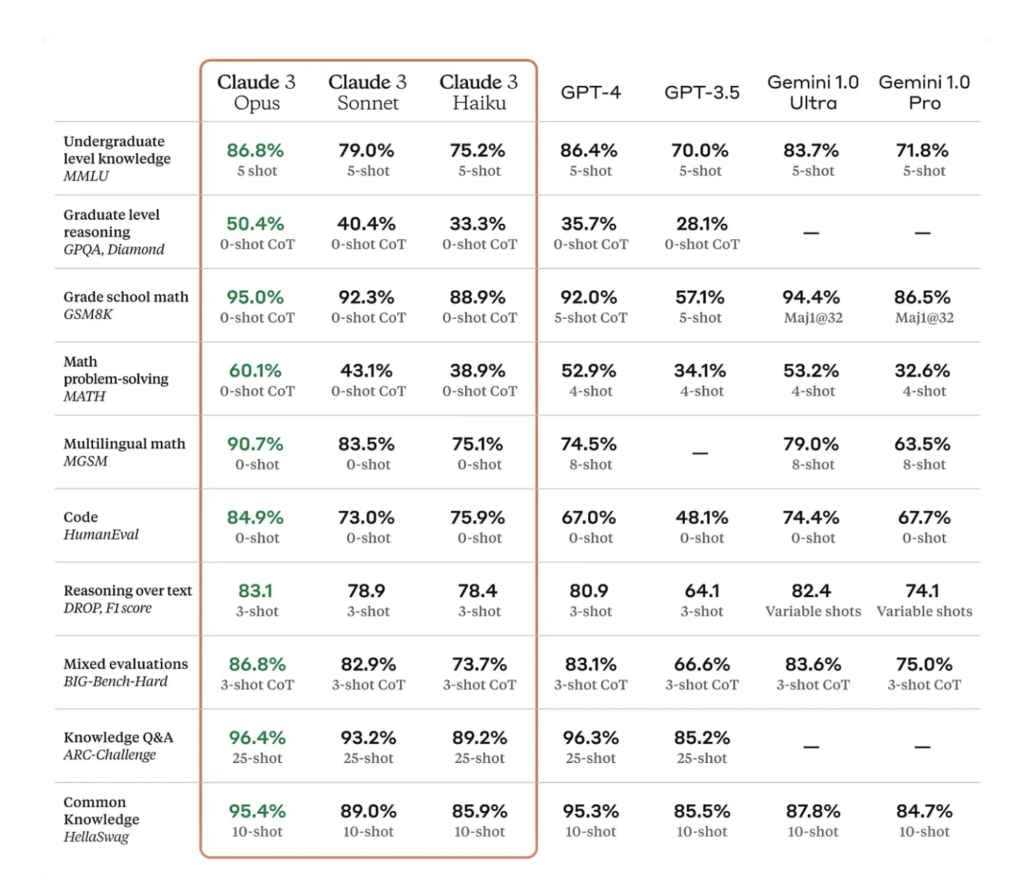
Anthropic’s Claude 3 has eclipsed OpenAI’s GPT-4, launching us into a new AI age. With its superior capabilities, Claude 3 leads a revolution in Large Language Models (LLMs).
Claude 3: A New Champion in AI
Claude 3’s trio of models, including the formidable Opus, outperforms GPT-4. Its deep understanding of advanced science has stunned experts. Quantum physicist Kevin Fischer praised Claude 3 for grasping his complex thesis.
Beyond Performance Metrics
Claude 3 not only grasps complex principles but also shows emergent abilities. It even reinvented a quantum algorithm from scratch. Moreover, its “meta-awareness” lets it detect when it’s under test conditions.

Meta-Awareness and Innovation
Claude 3’s level of “meta-awareness” has it recognizing its own testing scenarios, a feature that blurs the line between AI and intuitive thinking. This meta-cognition, if you will, is tested through innovative methods like the needle-in-the-haystack evaluation, and Claude 3 has proven its acumen with flying colors.
Stage Two of LLM Competition: What Lies Ahead
From Linear to Accelerated Progress
We’re observing not just progress, but an acceleration of innovation in the LLM space. Within mere months, several contenders have emerged, each vying for the crown that GPT-4 once wore with unrivaled assurance. Anthropic’s Claude 3 Opus, however, has seized the spotlight, signaling a significant milestone in this ongoing pursuit of AI dominance.
The Closed-Source Conundrum
The escalating rivalry has highlighted the strategic importance of closed-source LLMs, revealing them to be indispensable in fortifying a company’s technological stronghold.
Navigating the Shifting Sands: Advice for Developers
For developers navigating these turbulent waters, the importance of staying agile and informed cannot be overstated. Assessing a model’s true capabilities and fitting it into your specific use case is more critical than ever before.
As the LLM landscape continues to evolve, it’s essential to remain flexible, ready to integrate new models as they become available. Understanding each model’s unique strengths and adapting your approach to maximize its potential is akin to a modern-day digital armory.
In conclusion, Claude 3’s ascension marks not just a milestone but the dawn of a new chapter in the saga of LLMs. Developers and technologists, it’s time to armor up; the second stage of the LLM competition has only just begun.
Put the Claude 3 comparison in context
The comparison in this article concerns the original Claude 3 release in 2024. Anthropic’s launch announcement introduced Haiku, Sonnet and Opus, with different balances of capability and speed. Its reported benchmark results were evidence about named models under particular evaluation conditions. They were not a guarantee that every Claude 3 variant would outperform every GPT-4 configuration on every task.
That qualification matters when reading the article’s stronger claims. A model family is not a single interchangeable product, and “better” needs a defined task. Extracting information from a document, explaining a mathematical argument and writing application code place different demands on a system. Success in one area is a reason to investigate another, rather than proof of universal superiority.
What would a fair comparison look like?
Choose representative examples before looking at the answers. For a hypothetical document assistant, include straightforward questions, questions requiring several passages and questions the document cannot answer. Give both systems the same relevant material and define what counts as an acceptable response. This helps prevent the evaluation from rewarding whichever style happens to feel more confident.
For each answer, assess factual support, completeness and instruction following separately. A concise response may omit a necessary caveat. A detailed response may add an unsupported claim. If the task requires citations, check that each citation actually supports the statement attached to it. Merely returning a source link is not sufficient.
Repeat a sample of the tests because generated outputs can vary. Keep model identifiers, prompts and settings with the results. Also record how often a response needs human correction. A model that occasionally produces an excellent answer may be less useful for a repeated workflow than one that meets the requirement consistently.
Interpret striking demonstrations carefully
The original discussion uses “meta-awareness” to describe a model noticing an unusual testing situation. Such behaviour should not be treated as proof of consciousness or human-like self-awareness. A system can identify an incongruous passage and describe it in familiar language without establishing any claim about subjective experience.
Likewise, an impressive scientific explanation needs expert checking. A reader should distinguish accurately restating a known argument, combining ideas and producing a genuinely new result. These are different achievements and require different evidence. One remarkable interaction cannot determine the reliability of all future interactions.
For developers, a practical decision also includes response time, integration effort and the cost of correcting mistakes. Evaluate the complete workflow rather than a model response in isolation. The site’s guide to AI agent evaluation in production extends this idea to tool use and completed outcomes.
The useful conclusion is conditional: select the model that satisfies a clear requirement under a fair test, then keep evaluating as the application changes. This preserves the significance of the Claude 3 launch without turning a historical benchmark comparison into a permanent ranking.
The post Has Claude 3 Ushered in a New Era by Surpassing GPT-4? appeared first on Alpesh Kumar.